


Benjamin Heinemann undergoes rare ectopic banking following farm mishap
By Kyla Hurt
Editor’s note: This story describes injuries and medical procedures and includes photos that may not be suitable for all readers.
On September 18, 31-year-old Benjamin Heinemann suffered a freak accident involving a silage machine while working on a farm in Pisgah.
The accident, the injuries, that befell Heinemann on that Sunday afternoon are certainly nasty and graphic. Equally powerful still was the medical care which ensued, as it proved fascinating and skilled.
Heinemann, a Jacksonville native, says he was working for a farmer, and they had been chopping silage when the blower became clogged. He recounts: “We were at my sister’s house of all places, thank God … we were down the road a little bit where we were chopping at, but, yeah, where we were dumping at was right at my sister’s house. Basically, we dump the corn off into the blower, which grinds it up and shoots it up over the harvest store. So, that blower had gotten clogged … I’d actually just called my nephew as I was pulling in, to go on a couple passes with me … and he just got on the tractor with me. I told him, ‘We’ll get out there, but first you gotta help me. We gotta go and unclog this blower’
“Once the blower was unplugged and the PTO [Power Take Off] was slowing down on the tractor, everything was winding down … so, all the stuff was open from blowing out the machine, because there’s guards and stuff on it … then I had to get a ladder to make sure that the top wasn’t clogged either … so, I grabbed a ladder to climb all the way up, and as I was handing my boss the ladder … you know, they pulled it through and I, I was just looking down to make sure I wasn’t going to, like, trip over anything and when I looked down, I had already kinda been getting pulled forward a little bit from the ladder and it just all happened really fast as far as … I tripped over the concrete basin that the, uh, harvest store was sitting on … and it was a natural instinct to falling, I put my hand down and it barely went down and … [Heinemann makes two quick sharp sounds].”
Heinemann had reacted by throwing his arm down to break the fall — inserting his left hand directly into the winding down machine.
“It all happened pretty fast … I knew it was pretty bad,” says Heinemann.
It was.
The machine cut right across his 1-5 metacarpals.
Imagine a hand with the digits pointing up — the metacarpal bones compose the middle part of the hand. Each connects to one finger or a thumb at what is commonly referred to as the knuckle joint. So, the cut went through below the knuckles on his four fingers. Fully through.
He described his thumb as crushed. There was blood everywhere. His tendons were exposed and appeared almost recoiled. His left hand had been mutilated. The visual was gnarly.
Heinemann says initially seeing his hand in that state was crazy, but he gathered himself and assessed the situation to keep a strong mindset. It is his past that helped him find his best headspace. Expresses Heinemann, “I went through some tough sh*t to know that, uh, you can’t necessarily control the outcome … but to maximize the position to look at it in the best way possible … it’s just how you look at it.”
He acknowledged how his boss had promptly searched for the amputated fingers, adding, “I guess they were still in the machine.”
He also acknowledged how the proximity to his sister’s home made it possible to put the found fingers on ice quickly, saying it felt like a fast 2-5 minutes for that to happen.
So, with 911 called and his digits in tow, Heinemann laughs, “We hopped in the truck and flew into town.”
Heinemann arrived at Jacksonville Memorial Hospital and although he was in excruciating pain, he says he spoke to physicians about his past when they began to administer pain meds, telling them he was a recovering addict and could not have opiates. He jokes that they replied, “Ummm … you’re gonna need some, bud.”
A helicopter was coordinated and soon Heinemann was airlifted to Springfield Memorial Hospital.
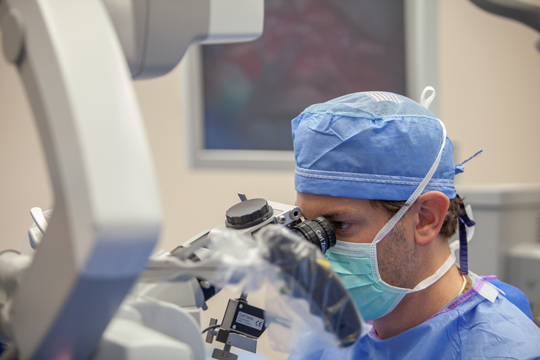
By some quirk of fate, Dr. Tim Daugherty, assistant professor of hand and plastic surgery at Southern Illinois University Institute for Plastic Surgery, was on call the day of Heinemann’s accident. Daugherty had only recently returned to Illinois from completing a hand fellowship in Baltimore at the Curtis National Hand Center, during which Daugherty received training in all aspects of hand surgery, specifically including ectopic banking — something Daugherty had not done before and learned during his fellowship.
It was Daugherty’s first weekend on call for hand trauma for SIU Medicine Plastic Surgery when he was contacted by Jacksonville Memorial Hospital. In fact, Daugherty was not originally scheduled, but had swapped weekends with another physician. One might call it fate. Heinemann was the perfect candidate for Daugherty’s timely training.
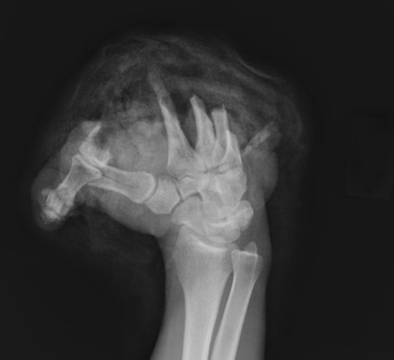
Daugherty explains, “Luckily, in this day and age with phones and technology the way that it is, you know … when I received the call from Jacksonville Memorial, the doctor on the other end had sent me photographs of what the injury looked like, and also the x-rays, which saved me time in having to evaluate or put him through pain in taking down the dressing to look at the amputation site. It also gave me the ability to start planning his surgery before he ever got here.
“So, I knew that I was most likely going to be doing ectopic banking to salvage his hand prior to him even leaving Jacksonville Memorial.”
By the time Heinemann arrived, Daugherty had already communicated with the operating room, and everything was set up and ready for him when he arrived at the hospital so that it made for a quicker transition to get to the operating room. Heinemann’s case was considered a surgical emergency.
“They were ready to rock when I got there,” expresses Heinemann about his arrival at Springfield Memorial.
Daugherty shares, too, that he was able to take the amputated pieces into the operating room to start working on them before Heinemann himself was in there. Daugherty confirms the status of Heinemann’s left hand, stating that the four fingers were completely severed and that his thumb was essentially smashed and was rotated due to a fracture that was maligned. The hand had an arterial injury, meaning that it did not have viable blood flow to it.
The initial surgery Daugherty performed on Heinemann — the ectopic banking — lasted 8 ½ hours.
Notedly, it was the first surgery of its kind to be done in the Midwest.
With ectopic banking, techniques are used to bank fully amputated body parts for later replantation.
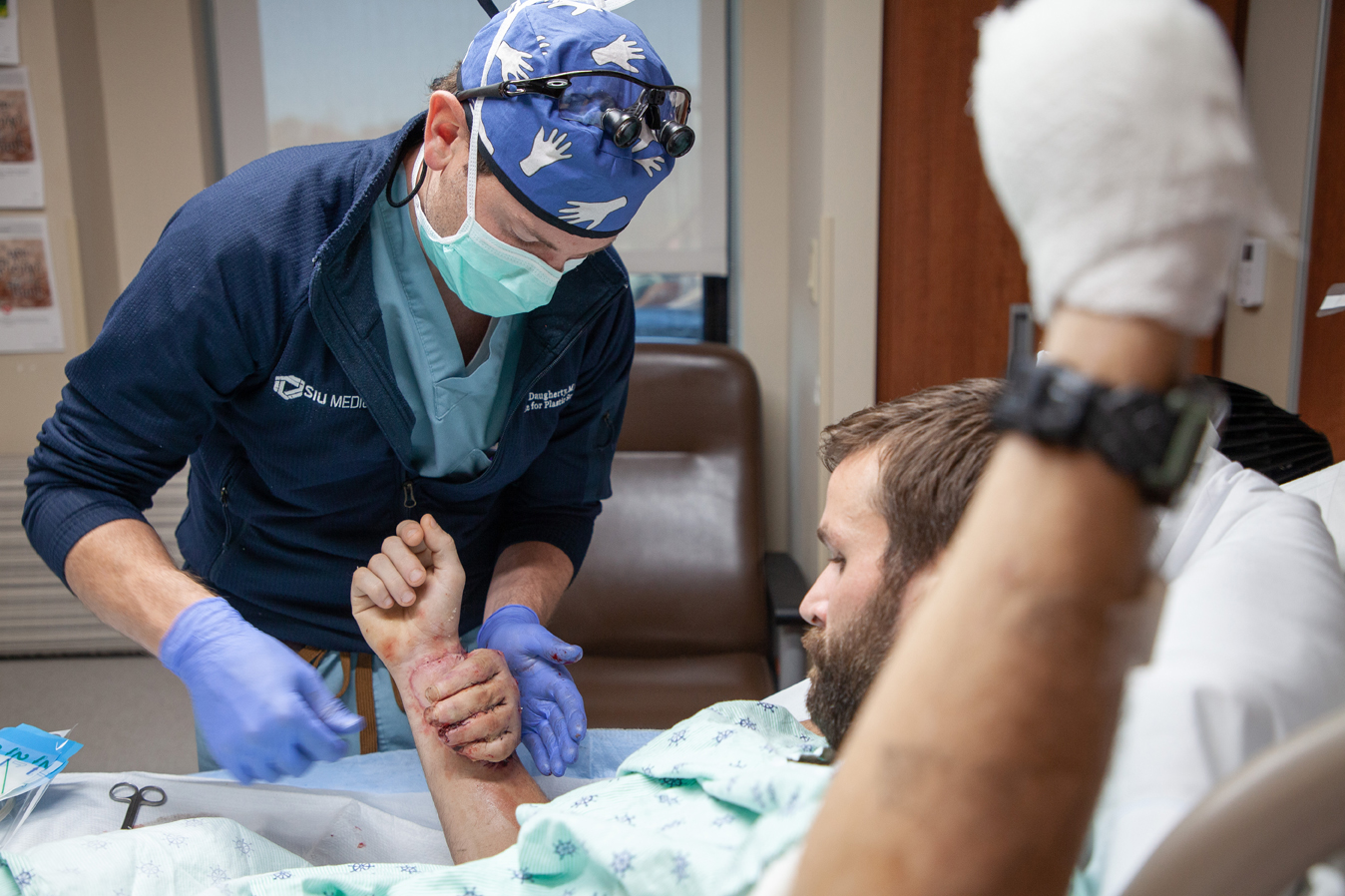
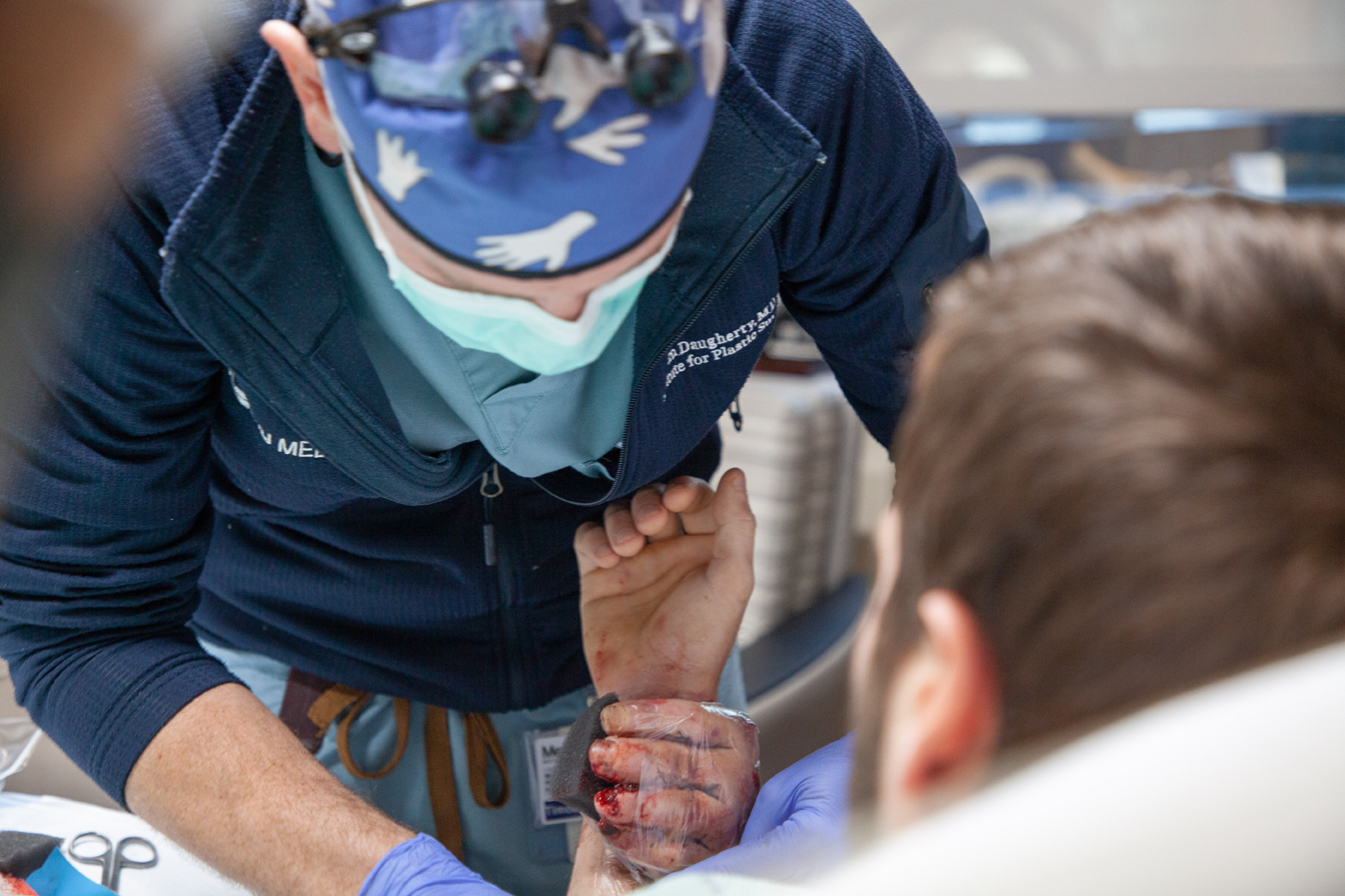
Daugherty explains, “I hooked up the radial artery to the, what we call the palmar arch, of the amputated piece. So, I hooked up the palmar arch to his right forearm radial artery, and I fixated the bones for stability … I fixated the bones to his radius using pins that went through the metacarpal bones of the amputated piece and through the radius of his right forearm.
“I also hooked up the veins to provide outflow … the purpose of putting it on his other side was basically to keep it alive. So, it was hooked up to the minimum things it needs to stay alive, which is arterial blood flow and veinous outflow. But it wasn’t hooked up to nerves, tendons, etcetera … it was just to keep it well profused, so that it was living … because the left side, the amputated stump, was too mangled to put that hand onto, and it was missing tissue, that would have required him to have a free flap or multiple free flaps the night of the injury in order to cover it.
“In addition, his flexor tendons were ruptured off of the bone, and had I put them back on the night of the injury and done a free flap, they probably wouldn’t have moved again, or he would have required multiple secondary surgeries in order to ever get them to move again … it was too bad of an injury to put back on at the time of injury.
“Basically, [the ectopic banking would] babysit the fingers until they’re ready to be put back on from where they came from.”
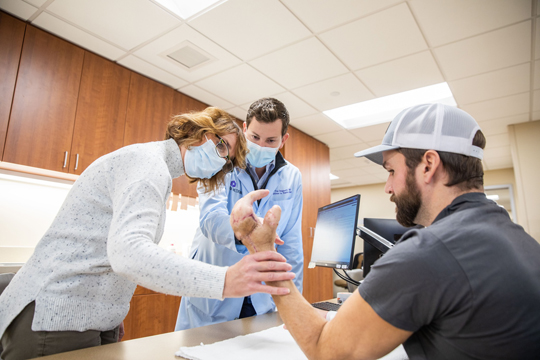
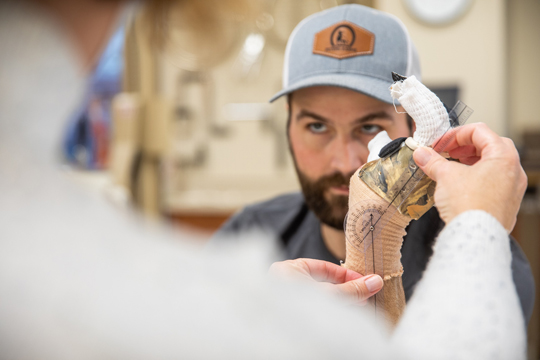
So, Heinemann’s left hand looked as if it was essentially protruding from the inside of his right forearm. His left hand remained there for six weeks.
Heinemann underwent 10 surgeries in the duration at the hospital. A few of those were planned surgeries to do coverage of the fingers, or of his left side with flaps (free tissue is taken from somewhere else on the body to provide coverage and prevent infection, for example). A few were unexpected surgeries because of blood flow problems. A few were planned debridements, a type of surgery to clean and remove necrotic (dead) tissue from the wound.
Heinemann talked about his various surgeries during his time in the hospital — he shares about his skin flaps, skin grafts, periods of debilitating pain and many weird sensations throughout it all. Tells Heinemann, “It was lots of innards becoming out-ards.”
Daugherty says, “My whole goal from the start was to try to give him more function than he would get with a prosthetic — more independent finger movement as well as sensation, which no prosthetic will give you — and to salvage all or most of the fingers. There’s no prosthetic that works like your own hand, and, you know, I think that anybody would want to try to save as much of their hand that was injured as he had.”
With the severity of Heinemann’s accident, it is amazing what medically could be salvaged — and it was miraculous that the timing of his accident and Daugherty’s recent training lined up. His condition could be very different if not for the events coinciding.
Daugherty says, “I think it was meant to be … I think all the stars aligned in order for he and I to meet … So, really, I think that it was meant to be that I was on call and able to help him.”
Heinemann agrees: “It’s not a coincidence. I don’t exactly know who or what God is, but that’s okay … all I know is that there’s something way better that creates all this and keeps me alive — not me. Me left to me is, whoa, lookout.”
He continues, “Everything happens for a reason. Had I not gone through my addiction and stuff, I don’t know where I would be with this … I probably wouldn’t even be in this position.”
Heinemann notes that his addiction was the hardest thing he’s ever been though — harder than this.
He says that it took a lot of courage and a lot of surrender. “It’s kept me grounded, knowing where I’ve been,” he explains, adding that it helps being grateful to be alive and having zero expectations.
He expresses that small communities are pretty powerful as far as supporting each other. He is grateful for all the support and prayers throughout this ordeal, and to all who have reached out.
Heinemann concludes, “God works in crazy ways … I thank God most of all.”
Benjamin Heinemann was discharged from Springfield Memorial Hospital on Monday, Nov. 21 — after 65 days in the hospital. He will need to undergo additional surgeries still and the goals are for him to have some form of function and sensation in his left hand at some point.
