
By Boehlke
On a windy day in August 2018 I pulled into Diamond Grove Cemetery – the largest cemetery in Jacksonville. My goal was to locate David Spencer, a local Civil War soldier.
The website, FindaGrave.com, had the location of his grave as section D, lot 160, After a brief stop at the sexton’s office, one of the workmen was kind enough to take me to section D, lot 160, located on the far south side, near Grove and Duncan Ave.
We stopped, got out of our vehicles, and walked over to some evergreen bushes. The cemetery worker stopped, pointed toward the ground, and said, “He is somewhere around here.” I saw no headstone nor any indication as to the location of David Spencer. Spencer, an African American Civil War soldier, was in an unmarked grave for over 110 years. I thought to myself, Spencer needs to be remembered, or at least marked.
Why is David Spencer important to Jacksonville history? Spencer is important because he was one of the three known African Americans who went from being a freedom seeker to helping freedom seekers on the Jacksonville Underground Railroad. Also, every veteran should have a headstone and, he was one of the 185,000 in the United States Colored Troops in the Civil War.
David Spencer grew up on a wealthy Morgan County farm, southeast of Jacksonville with the James Holmes family. Spencer was born enslaved on September 27, 1832, near the city of Lexington, Kentucky. When he was very young, his mother and five siblings were sold off.
Holmes, originally from Pennsylvania, was a contractor on the Pennsylvania Harrisburg Canal on the Susquehanna River in 1820. Ten years later, in 1830, he went to Kentucky to manage the construction of the Louisville to Lexington Railroad.
He later purchased farmland in Morgan County in 1832 and married Jane Vance in 1835. Vance, who was from Lexington, acquired David Spencer when he was two years old. When she came to the farm after marriage, three-year-old David came with her. The 1850 Morgan County Census listed David Spencer as 18 years old and working on the Holmes stock farm. At the age of 22, Spencer wanted his freedom from bondage, so James Holmes took him to the county courthouse to file a bond of $1,000, or about $39,000, today for “good behavior for the freeman” — or about $39,000 today. When James Holmes died, he had 840 acres, with a value of $63,000 (about 2 million dollars today).
In 1858 Spencer moved to Jacksonville from rural Morgan County and learned how to read and write by a teacher at one of the local academies in exchange for cutting firewood. Later he was able to receive more education at the Second Baptist Church Sunday School in Jacksonville. By 1859 Spencer, who was now 28 years old, married a local Jacksonville girl who was originally from Lexington, Kentucky, (Marcella) France Young, in Morgan County, Illinois.
David and France had 11 children in their lifetime. The married couple was listed in the William’s Jacksonville Directory and Business Mirror of 1860-61 as living on Marion Street between Church and Rockwell Streets, near Benjamin Henderson’s Underground Railroad home.
“My first exploit was in the memorable winter of 1853-54 for one night, I awake and drove up to William Olmsted’s on Grove Street with eight runaways. The signal was given, and a party unloaded and cared for. Money and supplies were raised and I was appointed to start with them to the great Western Railroad. We boarded the rear of the train just before daylight. When asked several times who my company was, I replied that they were friends from Chicago who had been here to spend the holidays. Soon after we start(ed), one of the men whispered in my ear that the old master was in the car a few seats ahead of us no doubt on the hunt for his property. I told him not to be afraid for I had a revolver with me and will use it if I had (to). To our great relief, the slave owner left the train at Springfield little thinking who had been riding with him. This is one of my experiences I had.” -David Spencer
David Spencer joined the Union Army as a substitute for the draft. During the war, draftees could hire a substitute to take their place. In this case, Andrew Roessler, a farmer from Rose Township, outside of Shelbyville, hired Spencer to take his place. Spencer, at the age of 32, mustered in on November 5, 1864, as a Private for the 13th Regular U.S. Colored Heavy Artillery. He went to Camp Nelson, Kentucky where he saw no action during his time. Camp Nelson was established in 1863 as a depot for the Union Army and a haven for contraband, army slang for runaway slaves. Spencer witnessed thousands of contrabands who came to Camp Nelson. On May 4, 1865, his yearlong enlistment was up and his last pay from the army was $32.64, or $617.00 today.
After he came home to Jacksonville, a few months later July 28, 1865, he bought lots 10 and 11 in the Simmons Heirs addition on the southeast side of town for $640.00, or $12,000 today. Later he bought a part of lot 32 from Abner Yates in 1871 in the Sanderson Addition and the family moved to their new house. The 1880 Morgan County Census listed him living on 1116 South East Street, working as a paving contractor until his death on October 18, 1914. At some point, his house was razed.
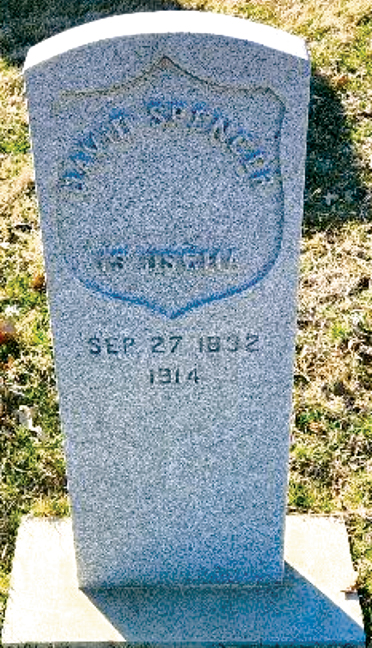
Anyone could request a burial headstone if the person severed before April 6, 1917, from the Department of Veterans Affairs. The form is VA Form 40-1330, a claim for a standard government headstone or marker. Before a person can fill out the form, military records are to be included. Spencer’s records are found at the websites Fold3.com and Ancestry.com, both are paid subscriptions. Once all the forms were filled out and a copy of his Civil War records was attached, the Jacksonville Monuments on East State Street took care of the rest.
Now, when you go to Diamond Grove Cemetery looking for Spencer’s grave, you will see a new, bright, shiny, new white marble headstone with David Spencer’s name, birth date, death date and his military organization carved in stone. He is no longer lost; he is now remembered.
