

Michael Fenner returns to the Appalachian Trail to complete what he started in 2022
By Eric A Thomas
In 2022, Dr. Michael Fenner embarked on a journey that most have only read about in history books or stories of outdoor adventures. The following is the story about the beginning of his Appalachian Trail (A.T.) hike.
That year Fenner completed almost two-thirds of the total trail. “By mid-September in 2022 it was clear that I didn’t have enough time to finish the complete trail,” he said. “The final mountain in Maine, Katahdin, closes to hikers in mid-October due to snow.”
From the beginning at Springer Mountain in Georgia to his stopping point for that year, it was 1,411 miles. It was a disappointment to Fenner to not complete the trail, or as it is referred to as the “thru-hiking” of the A.T. — but he knew he would be back.
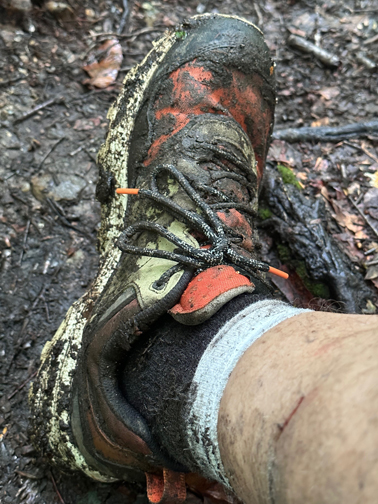
In May 2023, he returned to walk the portion of the trail that began at the Hudson River in New York and ended in Rangeley, Maine; this was a total of 566 miles. That year ended up being an extremely wet year throughout New England. “The mud in Vermont and New Hampshire was terrible and never did go away,” continues Fenner. “The combination of always being wet and poor-fitting shoes made a macerated mess out of my feet. I spent five weeks at home healing up from this.”
Because of the weather and the setbacks with the mud, he ran out of time to finish. By mid-September of 2023, Fenner was 60 miles into Maine but he still had 220 miles to go.
During this time the remnants of hurricane Lee passed offshore in Maine. Even though he was spared from the heaviest rains, the winds were strong. “The winds were strong enough to bring down tall trees,” he notes. He was fortunate to miss having a downed tree hit an area where he had just walked.
As he was planning his final segment hike, he decided to go back to the beginning of the Appalachian Trail in Georgia — as he said, “just for fun.” So, in February of this year, he hiked the first 100 miles for a second time! While still mountainous, the southern part of the A.T. is much gentler than the northern sections. New England has more dramatic scenery, but the miles are much more challenging. “Back in Georgia I was surprised at how easily even the 4,000-foot peaks could be climbed and how nice the trail was to walk on,” remembers Fenner.
When he started back this year to finish the last
segment of the A.T., he decided to wait until July in hopes of drier conditions and fewer black flies compared to May and June. In general, the conditions were overall more favorable than 2023.
“Most of these stream crossings in Maine are not bridged. Hikers have to cross in the water over slippery rocks,” Fenner reports. “Water depths ranged from knee-high to waist deep this year. In 2023, hikers were crossing in streams where the water was up to their shoulders.” Fenner was told by a Baxter State Park ranger that a hiker is killed once every three years on average trying to ford one of Maine’s rivers. A hiker died in 2023 crossing a swollen stream in New Hampshire.
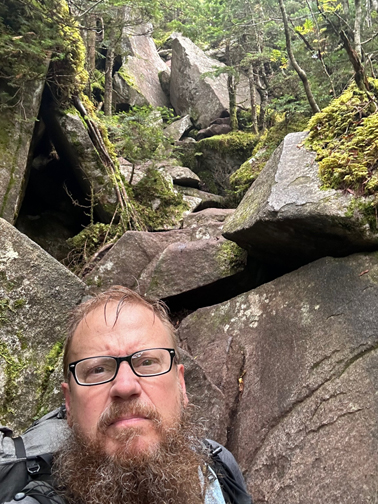
During this final section of the Appalachian Trail, he would be entering a section that brought him some level of fear. Known as “The 100-Mile Wilderness,” it is a stretch of land in Maine where there are no towns nearby and only a couple of rough logging roads available to give vehicles access to the trail. Throughout this area there was no cell service. “In other words, I’d be on my own for 7-9 days with little chance for a rescue if I had a fall or had a mishap,” he remembers. “As it turned out, the HMW was one of the most spectacularly beautiful sections of the entire trail.” He talked about the pristine ponds, white water gushing through narrow canyons, moose bugles and calls of whippoorwills at dawn. “I was sad when the week came to an end.”
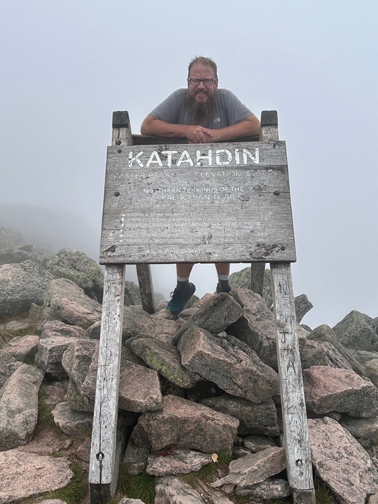
Fenner completed the final leg of the A.T. on July 29, 2024. It was his 165th day of hiking for 2024. Including rest days and breaks at home during 2022, 2023 and 2024, he devoted 349 days to walking the complete trail. “Looking back now, I do have an appreciation for the amount of time and work that I expended to get this job done,” Fenner adds. “My perseverance with seeing my goal to its completion and my wife’s patience and understanding throughout this endeavor are the two things I’m most pleased with. It’s an inner feeling of satisfaction.”
Fenner shared some final reflections about his journey.
Things that got old after 2,197.4 miles: being bitten and pestered by mosquitoes and flies, hiking around and through mud pits and swamps, the tedium of doing the same thing day after day, and his body smelling like rotten garbage.
Things that bothered him less than he thought they would: carrying a backpack every day, his legs and feet always hurting more than his shoulders did, the lack of music and other entertainment options, and sleeping on the ground in a tiny tent.
Things that never got old: meeting and talking to smiling, happy day hikers who were out for a nice walk in the woods and “who didn’t smell like rotten garbage,” the wonderful surprise of coming across strangers offering trail magic – free food for starving hikers! A man called Chilly P fed him before he climbed Katahdin. “I had two hamburgers, one grilled sausage, two bags of chips and four Cokes,” Fenner recalls.
Other forever memories for Fenner include cool breezes on warm days, warm sunshine on his skin on a cold day, the taste of cool water from a clear spring, sleeping next to the sound of falling water, meeting and talking with strangers along the way, and coming away feeling like he had one more friend in the world.
Fenner retired as a beloved Jacksonville surgeon four years ago. He enjoys traveling, cooking, writing, doing yard projects (big and small) and spending time with family — human and 4-legged varieties.
