

The Strawn Opera House on the square in Jacksonville will once again inspire awe
By Greg Olson
Nineteenth-century businessman Jacob Strawn had at least one thing in common with present-day entrepreneurs Rabbi Rob and Lauren Thomas — leaving a mark on one’s community.
The Thomases are now the owners of the remnants of the Strawn Opera House, a once landmark building on the south side of the Jacksonville square that wealthy cattle farmer Jacob Strawn had constructed between 1859 and 1861.

The Thomases plan to have the once grand entertainment venue reconstructed to mimic much of its original exterior appearance but with a different interior layout.
Current plans for the new Strawn Opera House include restaurant, retail or entertainment space on the first floor with a lobby that “honors the history of the building” and other buildings on the square that the Thomases are renovating, according to Rabbi Rob Thomas.
He said their ideas for the upper floors of the opera house include office space, possibly apartments and a clock tower with faces on all four sides.
“The current plan is to rebuild the upper part of the building and construct a second and third floor,” said Rabbi Rob Thomas. “The materials used to do this have yet to be determined, but it will have the exterior look of the original Strawn Opera House.”
Being sympathetic to the history of the buildings the Thomases have purchased in the past 18 months is at the forefront of their renovation decisions.
“I think every town square in the country should have a building that represents the history of the square as a symbol of progress, growth and relevance,” said Rabbi Rob Thomas. “Look at the famous people who graced the stage of the Strawn Opera House.”
Among the 19th-century notables who spoke there were Buffalo Bill, Horace Greeley, Mark Twain, Frederick Douglass, Oscar Wilde, John Wesley Powell, Edwin Booth and Jenny Lind.
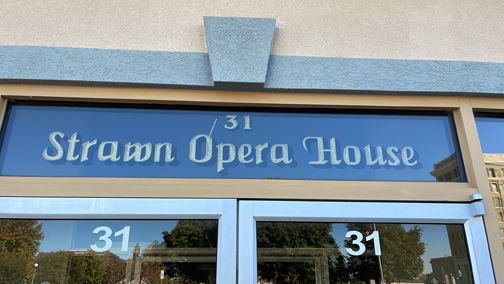
The Strawn’s stage curtain came down for the final time in dramatic — albeit tragic — fashion in 1887, when fire gutted the building. The building was rebuilt, but it never again hosted famous lecturers or entertainers.
Fire struck the building again in 1922, necessitating the construction of a new façade but causing little damage to the building’s original eastern exterior wall.
Much of the exterior then remained unchanged until 1988, when part of the roof collapsed and pushed most of the second floor’s east and south walls to the ground. Again, instead of leveling the whole building, owners at the time tore off the remains of the upper story and built a roof over the first floor.
And that’s what the Thomases are working with at the Strawn Opera House today, while at the same time renovating several other buildings on the square.
Rabbi Rob Thomas said work on the Strawn Opera House should begin next spring and could take 18 months to complete.
Within the past 18 months, the Thomases have purchased and are simultaneously renovating the following: the Andre & Andre building (formerly Sears) at 46 N. Central Park Plz.; the Kresge building at 59 E. Central Park Plz.; the Hopper shoe store building at 201 E. Morgan St.; the Osco building at 45 S. Central Park Plz.; and the Woolworth building at 39 S. Central Park Plz.
In addition, the Thomases are renovating the former Eight Wheeler Roller Rink building at 1204 Lincoln Ave.
Philanthropy is at the heart of the Thomases’ renovation efforts.
“Everything we’re investing in the buildings to renovate them and make them suitable for modern uses is 100 percent philanthropy,” said Rabbi Rob Thomas. “There will be no return on our investment. However, everything we’re doing will support a profitable building, which ensures the necessary capital to keep these buildings stable and beautiful for decades to come.”
Housing is the driving motivator for all of what the Thomases are doing, according to Rabbi Rob Thomas.
“The idea is to create an urban vibe on the downtown square,” he said. “If we can draw more young professionals to Jacksonville, some percentage of them will be entrepreneurs. They will see gaps in the market that no one else will recognize, and they will start companies to address those gaps. Filling those gaps means more hiring, more jobs and a more diverse economy.”
The Thomases said their plans are already taking shape.
“Demand for space has far exceeded our expectations,” said Rabbi Rob Thomas.
On top of that, he said he has enjoyed coming home to Jacksonville, where he grew up, and his wife, Lauren, has fallen in love with the town.
“I adopted Jacksonville and Jacksonville adopted me,” she said. “I just love it here. And we really enjoy driving around the square and seeing the progress on our buildings. We’re excited about the future of Jacksonville.”
