
Pritzker says city gets $2 million to help with housing, alludes to cleanup of JDC grounds
By Ben Cox
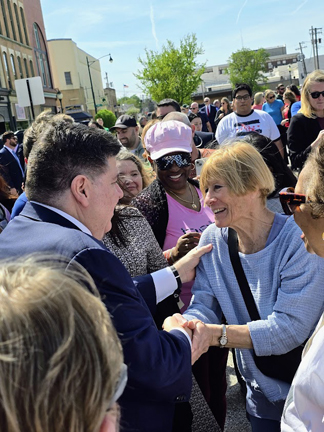
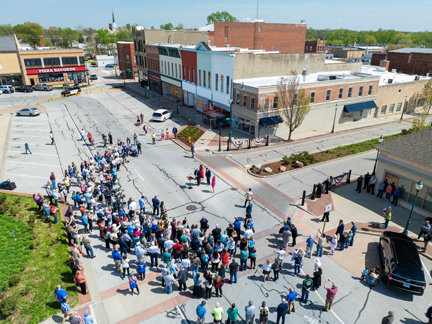
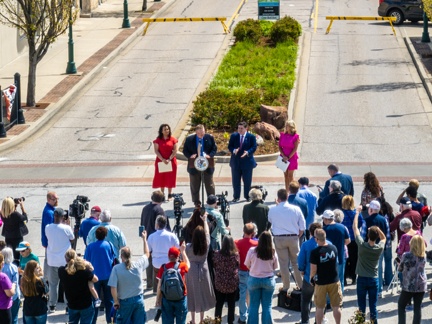
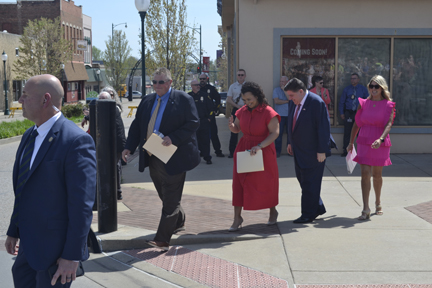
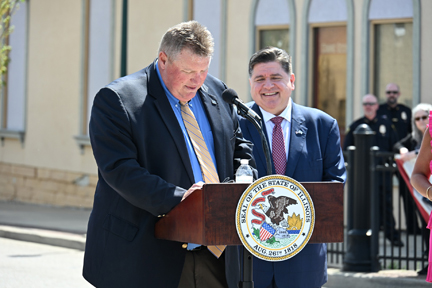
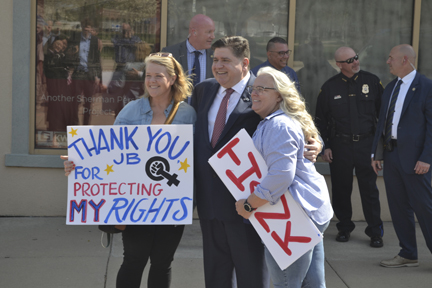
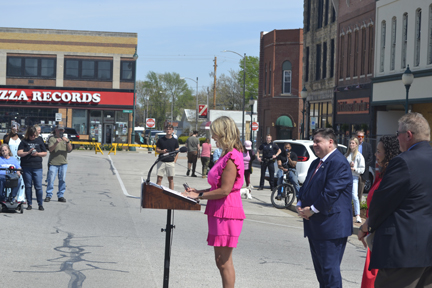
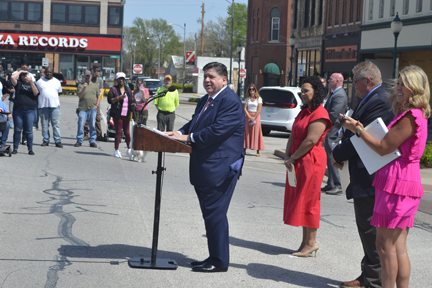
Governor JB Pritzker visited Jacksonville on April 22 to announce state-funded grants totaling $30 million for 25 grantees through the Rebuild Illinois Downtowns and Main Streets (RDMS, $20 million) and Research in Illinois to Spur Economic Recovery (RISE, $10 million) programs to revitalize commercial corridors and downtown areas throughout the state and accelerate local economic initiatives.
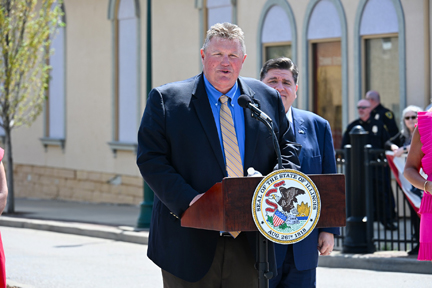
The City of Jacksonville is receiving $2 million from the RISE program in order to build workforce housing in the city in order to address the city’s affordable housing market disparity. City of Jacksonville Mayor Andy Ezard appreciated the work of the Pritzker administration’s work for the grant in his remarks in downtown Jacksonville: “Governor, you’re support represents a significant investment in the future of our city and helps the potential to develop workforce housing, which in turn will motivate and have a lasting impact on the lives and future of our residents. In my eyes, that is good government.”
Pritzker said the investment in Jacksonville is similar to the other grantees through both programs: “As governor, one of my top priorities is to reverse decades of neglect and broken promises and bring jobs, opportunity, and hope back to communities across Illinois, while breathing new life into our downtown corridors and beyond. This program will directly support 25 communities across the state by funding critical community development projects, housing and infrastructure all while revitalizing commercial corridors.”
Pritzker’s remarks went beyond just the RISE grant awarded to the city. The governor alluded to the Surplus to Success Program, which is currently a part of his FY26 budget proposal that is currently in front of the Illinois General Assembly.
“I have proposed that the state put up the dollars to tear down and repurpose old and decrepit state-owned buildings like the former Jacksonville Developmental Center. It will allow our communities to redevelop those sites. Jacksonville isn’t alone in receiving this help from the what’s called the Surplus to Success Program. Across the state, there are state properties that are a headache for local police and fire departments, a blight on community landscapes and a constant reminder of the years of neglect and decline allowed by state government. Instead, these properties can symbolize the renewal of our engines of economic success for our cities and towns. Jacksonville is one of the first cities that will benefit from this revitalization effort.”
Kristin Jamison, president of the Jacksonville Regional Economic Development Corporation, says that the workforce housing development will help local businesses and industry to further grow its base: “The City of Jacksonville exudes small-town charm with big city amenities, which is helping us bring new people here to work and do business. Funding from the Rebuild Illinois Downtowns and Main Streets Capital Program and the Research in Illinois to Spur Economic Recovery program will afford the City of Jacksonville opportunities to further improve our downtown district and bolster workforce housing — critical resources that will strengthen the entire Jacksonville region.”
The $2 million will allow local leadership to identify a site in the city to build a new development of workforce housing, which is currently lacking in the city’s housing stock.
What is Workforce Housing?
Workforce housing is addressing the need for affordable housing options tailored to middle-income working families in Illinois. This initiative aims to provide housing that is attainable for households earning between 80% and 140% of the area median income (AMI), a group that has traditionally had difficulty finding affordable homes in Jacksonville over the last decade and often is underserved by traditional affordable housing programs.
Workers who traditionally fall into the area median income for Morgan County include new teachers, new police officers, nurses and EMTs, retail managers, skilled trade workers, factory workers, administrative professionals and frontline utility and trade workers.
The median household income in Jacksonville as of 2023 was $62,615, according to the U.S. Census Bureau. Workforce housing for Jacksonville would support families earning between $50,000-$87,600.
Traditional affordable housing programs like Section 8 through the federal Housing and Urban Development office say these groups make too much money. Those programs typically serve folks with an AMI below 60% of the median income.
Housing developments and landlords typically attempt to attract higher wage earners in order to attract a steady income or a buyer, leaving a gap in the middle for a growing workforce or for young professionals out of college or trade programs. Workforce housing does not equal housing or government-supplement housing.
Workforce housing traditionally comes in the forms of duplexes, townhomes or modest single-family homes and in some places fixed-rate rental apartments. In some areas across the country, it may also involve a public-private partnership where the state or city helps offset costs to developers in exchange for keeping units affordable.
Where did the grant come from?
The City of Jacksonville, in partnership with the Jacksonville Regional Economic Development Corporation, engaged with the Illinois Housing Development Authority four years ago to create a Community Revitalization Plan, which the city council adopted in 2023.
The plan was developed after a community survey and a pair of public hearings with IDHA officials to identify issues with the city’s housing stock and the 7% population shrink that had occurred over the course of the last decade.
The City Development Office along with volunteers also took a housing stock survey in 2021 to identify all of the inhabited and uninhabited homes in the city limits. The housing stock survey helped city officials identify problematic areas as well as areas of potential for development through the Two Rivers Land Bank and through other assistance.
What is the Surplus to Success Program?
Pritzker’s FY26 budget proposal includes a program worth $500 million for new and existing site readiness programs. The budget allocates $300 million to the new Surplus to Success Program (a state site readiness program) at the Department of Central Management Services (CMS).
Another $200 million will be allocated to the Department of Commerce and Economic Opportunity (DCEO) to support and expand existing site readiness efforts to encourage private and other public sector investment to turn unused and abandoned properties into appealing sites for business attraction and development.
In addition to the $500 million in new funding for site readiness programs, $200 million will be dedicated for the Capital Development Board (CDB) to demolish and remediate non-surplus unused state property.
Working in collaboration, CMS and DCEO will evaluate state-owned sites located in areas of the State that are experiencing growth or have existing assets, such as power supply and proximity to workforce, which would be attractive for private development or local public re-development.
Unused land owned by state government is an inefficient and costly drain on state resources and does not contribute to local property tax rolls. By utilizing this unused state-owned property, the program will provide land for business and residential development and will bring state-owned lands back onto local property tax rolls. CMS and DCEO have already identified several deteriorated surplus properties as attractive site development projects. Jacksonville is on a short list of five sites that include Dwight, Rockford, Lincoln and Kankakee.
Unlike these four properties, the JDC property lies in the heart of the city rather than near the city limits or on the outskirts of those municipalities. “The idea as you may know is that [the state] has got these decrepit facilities that are empty,” Pritzker said in Jacksonville on April 22, “They are costing money for local communities – your police, your fire departments have had to deal with problems at those locations. What we are trying to do is – and I mean this is something that should have been done years ago, I think we would all agree. I hate to say it as during my time as governor there have been many, many things that have been neglected before my time as governor. Some of them you can’t just snap your fingers and make happen in one year. We’ve got to have the appropriate resources and the will of the legislature to do those things. But, I believe we are going to get that done in this budget this year. What’s going to happen is – and it will be a decision by [the Jacksonville] city council, by the mayor, by all of you about what should happen with that property. In some cases across the state, they could revitalize the building by leaving it in place. I do not think that’s the case here [in Jacksonville], and again that’s up to you to decide but the idea is to make available to the [city] the capital that is necessary for you to prepare that property for what it ought to be.”
Pritzker went on to remark that the JDC grounds have been a “thorn in the side” of the city and its residents for the past 13 years since the site went idle. Pritzker urged residents to communicate with their leaders to vote for the budget with the program inside so that the state could move “expeditiously” to get the site remediated when the funds were appropriated. The current FY26 currently does not have a bill number, but is expected to pass sometime next month before the spring legislative session comes to a close.
