
By Ben Cox
Walt Moad was not originally looking for a job at Bound to Stay Bound Books when he walked through the doors 25 years ago, but that’s what happened. He arrived on-site after giving someone else a ride to get a job 25 years ago, and quickly found work.
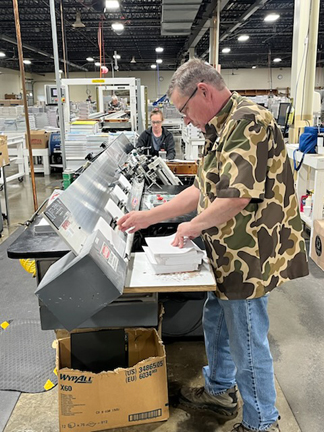
He’s held a variety of positions with the company and is cross-trained in others but currently holds the title of flyleaf operator. Walt Moad tells his story:
Ben Cox: What brought you here in the first place?
Walt Moad: Actually, I didn’t even apply for a job here. I gave a kid a ride to apply for a job, and they needed someone to build some tables. Lori [Smith]’s husband, Andy, took me back and asked me if I could build these tables, and so I started building them. Then one thing led to another, I ended up going back into Department 15 where I was in sheet and cut for 11 years. That’s how I got here. I wasn’t even looking for a job, but yeah, when I got it, it was kind of weird. Yeah, I’ve been here ever since.
BC: Decided to stay, too, it sounds like.
WM: I like this job. I do. It’s got good benefits. It’s just a good place to work. It really is. And all the people I work with are actually really good. They’re all the best of the best. They’ve been here a long time.
BC: I keep hearing “family” from other people.
WM: Yeah, we’re a lot like family. A lot of people don’t realize it, but you spend more time with your coworkers than you do your actual family, especially if there’s two of you and both of you have a career or whatever you do. You sometimes don’t get a lot of time to spend together, so you will spend more time at work with your coworkers.
BC: Have you seen any major changes out on the floor as far as production over the last 25 years?
WM: Oh yeah. When I first came here, there were 320, I believe, 325 of us. Now, I want to say 80. And a lot of things have gotten more modern. And, of course, all the workers I work with, they’re the best of the best. So, through the years, they kept the good ones and the ones that didn’t like it as much, they would just move on.
The biggest change though, I have noticed is they started cross-training people a lot and we found out that everybody could do a lot of different jobs and they’re all really good at it. That was probably our biggest advancement. Then, of course, a lot of new equipment to make it better, and we did get some good stuff, and that helped out a lot, too.
BC: I heard there was a reduction of the night shift in that time.
WM: Yeah, we’re just not busy enough. Back then we were doing about 50,000 books a week. We don’t sell that many books a week now, but we still do 25-30,000 a week, which isn’t too bad. Of course we do it with about a third of the crews, so about half the work with about a third of the crew. So that’s probably the biggest difference that a person would notice. When I first came here, you could walk in here, all you could see was people everywhere. I mean, you just couldn’t even hardly turn around without bumping into somebody. Now we’ve got a lot of space and we’ve just gotten better at what we do, and the equipment’s helped, too.
BC: Do you live here in Jacksonville?
WM: I live in Woodson. I came here from Springfield. I actually liked it so much that I said, ‘You know what? I’m going to move to a small town.’ Springfield was kind of getting big and it wasn’t that much fun to live there anymore. It’s not that safe there anymore. So I feel safer living [down] here.
BC: The other thing that I’ve heard a lot too is that longevity. You’ve been here 25 years. Are a lot of the coworkers you have been here that long?
WM: They have. In fact, we only have maybe a couple here and there that haven’t been here a very long time, but they like it, too. I think something that really helps here is we’ve got such a great benefit package. Our benefits are just, we don’t even have to pay for them. They’re supplied or provided for us. Now, if you add your family, of course you have to pay for it, but for like me, it’s just me. So it is great. I don’t have to pay any money out at all. And they’re good benefits, and I think that that’s why that’s one of the most important things now, I think, especially when you don’t have to pay for it. My wife’s in the medical field and she has to pay for her insurance. It’s outrageous. I can’t believe how much she has to pay, but I think the more you make, the more they charge you.
BC: When you tell people you work here, do they ask you, well, what exactly happens there or what do you do there?
WM: I’ve had a few people, and a lot of people think that we’ll actually do the whole book here. They don’t understand that we’ll tear a cover off and that is what we do. We’re just trying to make a book kid-proof. They have to be durable and hold up. So, a lot of people are checking them in and out of the library.
When I first came here, I didn’t understand what they did either. It took a while to figure that out. But yeah, I had people ask us that or ask me that, so what do you do out there? Or what is it exactly that you do? And I tell ’em that and they’re like, huh, really? So, you take a perfectly good book, you take the cover off and then put a new one on it, but they don’t understand.
When we do that, we take the cover off, of course, we size it up, we make sure it’s cut real nice and even and everything. Then we side sew it, which makes it really tough, so the pages aren’t going to fall out and it’s been glued. Then, of course, we put the fly leaves on it and then we put the cover on it, and they are hard to tear up. I mean, I can take just a regular book that comes from the publisher and just take the cover off like that. You can’t do that with our covers. You’d have to cut them out. I mean, there’s a big difference.
BC: Do you find it pretty neat that the stuff that you make goes all over the country?
WM: It is pretty neat. I even asked Mr. Sibert a strange question that I always wondered about. I know that this is kind of crazy, but I wondered if Lee Harvey Oswald was actually putting his [rifle] on one of our boxes [in 1963]. We sold books to the [Dallas Books] depository, and I asked [Mr. Sibert], “Do you know if we had any books that were in there at that time?”
He didn’t have any receipts to go back far enough, but he did look it up. He said no one had ever asked him a question like that before. There is a lot of history there. But it is neat. And then of course, you look at states like our oil states are our biggest customers Texas, Pennsylvania, Arkansas, Oklahoma and Alaska. They buy more books because they take the income from the oil and they invest it in their education, so that helps us out a lot, too. But yeah, from New York to California, from Florida to Arizona, California, again, we sell to every state.
BC: I see many Bound to Stay Bound Books here in Jacksonville as well.
WM: What’s really nice here, of course, is Mr. Sibert likes to make sure our books are out around in our community, too, so he donates a lot. Sometimes schools may not have a big enough budget. He’ll say, well, we’ll send it on over. He’ll take care of them. They are a pillar of the community for sure.
BC: Is that another thing that kind of keeps you here, makes it attractive to work here, is that they do so much for the community and for the family of workers?
WM: It is. And they do care. Jobs anymore — they’re not like this. People come and go so fast, and of course lots of places sell off. Of course, you’ll get a CEO or someone in there. It’s just not the same. And this is still a family run business. That’s what I find attractive about it, is that it’s run well, and [Mr. Sibert] cares. Definitely.
BC: Do you find it odd that you know the owner and CEO of the company?
WM: I do, because he’s a very normal person. He’s actually somebody and he never acts like it. He knows everybody here. He does. But yeah, I thought that it was strange that a CEO would take the time out to get to know their employees. They say his dad and grandfather were the exact same way.
