
By Chad Boehlke
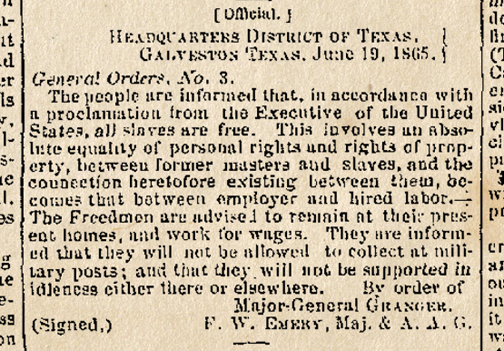
Galveston, Texas, June 19, 1865.
General Orders, No. 3.
The people are informed that, in accordance with a proclamation from the Executive of the United States, all slaves are free. This involves an absolute equality of personal rights and rights of property, between former masters and slaves, and the connection heretofore existing between them, becomes that between employer and hired labor.
The Freedmen are advised to remain quietly at their present homes, and work for wages. They are informed that they will not be allowed to collect at military posts; and that they will not be supported in idleness either there or elsewhere.
By order of Major General Granger
F. W. Emery, Maj. & A. A. G.
Juneteenth, a significant annual national holiday, holds a pivotal place in American history as it marks the end of slavery in America. The term ‘Juneteenth’ is a blend of June and nineteenth, the date of General Order No. 3.
This order, a crucial document, declared the freedom and equality of all enslaved people. The celebration of Juneteenth, which originated in Galveston, Texas, gained momentum as news about the General Order spread across the nation, making Juneteenth a cherished celebration in many Black communities. Jacksonville resident Thomas Smith was present in Galveston when General Order Number 3 was first announced, witnessing a momentous event in the history of the United States. The significance of Juneteenth as the end of slavery is a powerful reminder of the progress and resilience of the African American community.
Thomas H. Smith, a man who was born into slavery in 1825, embarked on a remarkable journey to freedom. His master, an Alabama lawyer named David A. Smith, who later became a friend of Lincoln, freed all his slaves, including Thomas. Thomas and the other formerly enslaved people followed David Smith to Carlinville, Illinois, in 1837 and later, in 1839, to Jacksonville. It was in 1854 that David Smith built his house on Grove Street near Illinois College, a testament to the progress and freedom that Thomas and his fellow former slaves had achieved. This journey from slavery to freedom is a testament to the resilience and determination of Thomas H. Smith.
After his emancipation, Thomas H. Smith built a life for himself and his family. In 1851, he married Dolly Ann Hale in Morgan County. About 10 years later, the 1860 Morgan County census listed Thomas as a 35-year-old barber living with his 28-year-old wife, Dollie, and their five children. They resided in or near the part of Jacksonville known as ‘Africa,’ a free African American community. The ‘Africa’ community in Jacksonville was a significant part of the post-emancipation era, providing a safe space for African Americans to live and thrive. The couple owned real estate valued at $500, which indicates a structure such as a house on their property, a testament to their hard work and success in the face of adversity.
On February 12, 1865, at 40 years old, Thomas Smith joined the 29th U.S. Colored Infantry (USCI), Company A, at Quincy, under Captain Robert Porter. During enlistment, Thomas was engaged in the Battle of Five Forks and the Appomattox Campaign, which ended with the surrender of Robert E. Lee at the McLean House near Appomattox, Virginia. After the surrender, he became part of history when the 29th USCI was dispatched from Virginia to Mobile, Alabama, before heading to Texas. Storms plagued the ensuing expedition, and once the men reached their destination, the regiment went ashore at Galveston, Texas, on June 18, 1865, when General Gordon Granger posted General Order No. 3 on June 19th. The 29th USCI was in garrison on the Rio Grande River from June until it mustered out at Brownsville, Texas, on November 6, 1865. It turns out that Jacksonville had other soldiers from the 29th USCI present during General Order No. 3, Robert Arbuckle of Company E and John Barker of Company A. Both men are members of the Grand Army of the Republic, Governor Richard Yates Post 687, an all-African American Post in Jacksonville and buried at the G.A.R. plot at East Cemetery.
For African Americans, joining the army sometimes meant taking a financial step. Just before Thomas was mustered out, he and Dolly were in the process of building a house. They sent home money to fix up the family wood-frame home on Grove Street. Records showed that on November 30, 1865, Dolly Smith made a $50 house interest payment to David Smith. The following month, $65 was spent plastering the dwelling and laying a foundation. Thomas spent a total of $285 on the house.
By 1870, the Morgan County Census listed Thomas as a barber, but he lived with Lewis Hunt, a 22-year-old Black barber. The census also showed that Thomas and Dolly were not listed in the same household, and only Dolly was living in the house with the children and taking in washing to make ends meet. The census also listed Mary Smith, possibly Thomas’ mother, as living with them.
Barbering offered a secure living and a traditional trade to enslaved men who gained freedom. Sometimes, Black barbers supplemented their income by taking on apprentices; perhaps Lewis Hunt was learning the trade. Dolly died in 1878 and is buried in East Cemetery alone; Thomas’s grave was never located.
