
By Chad Boehlke
Photos/Special to The Source
If you walk through Jacksonville East Cemetery as often as I have, you’ll happen across interesting headstones, each with a story connected to the person laid to rest.
Additionally, Jacksonville East Cemetery holds a few “memorials” dedicated to individuals—except for one.
One of these stone memorials is located at a corner of the cemetery, with “Social Domestic Science Club” carved on top, and a list of women’s names and dates on both sides. Every time I walked past this stone, I wanted to know what this club was and who these women were.
The Social Domestic Science Club is an educational group in which members share information on household management, cooking, sewing and nutrition. Its mission was to create efficient and healthier homes – a type of home economics.
The women listed on the stone monument were part of an African American domestic science club that was not just about cooking or sewing but also focused on the local educational and social needs of the Jacksonville Black community. This club in Jacksonville seems to be an independent entity, operating locally and not part of a larger organization.
FORMING THE CLUB, 1906
The club was first formed on March 24, 1906, with a notice in the Jacksonville Daily Journal advertising the first meeting, held at the home of 40-year-old MillieDavis at 137 South West Street. She passed in 1926.
The officers elected at this first meeting included president Lydia Coffman, second vice president Mrs. D. D. Thomas, secretary Nannie J. Blue, assistant secretary Mamie Edwards, treasurer Lucy Bolden and chaplain Mattie Powers. Mary Louisa Kirk served “dainty refreshments.”
According to the Jacksonville Daily Journal, the club would meet at the members’ homes every month, often on Friday afternoons. The meetings were a blend of business meetings and a social hour with refreshments.
Elections were held annually for the officer positions. The women would present papers on various subjects along with musical solos. The club always had many guests who would attend that would also be listed in the newspaper.
THE JACKSONVILLE EAST CEMETERY MONUMENT
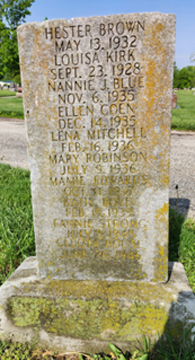
As far as I know, records from this club no longer exist, so the reasoning behind a stone memorial is lost to time. But for many of these women, this memorial has become their tombstone. The memorial listed 20 African American women with their dates of death. It was Ellen Coen who purchased the lot 12 for the memorial stone at the corner of Hamilton Drive in Jacksonville East Cemetery. Coen and her husband are buried on the lot, among others who were not club members.
It is believed she purchased the stone as an alternative to a private headstone. Records do not reveal exactly when the stone was bought or installed; it may have been put in after 1935, when Ellen Coen died.
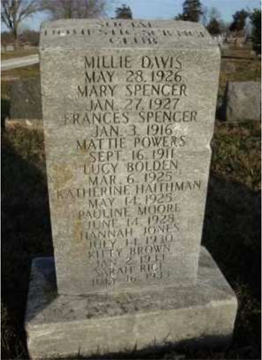
The stone contains the following names with death dates:
Millie Davis: May 28, 1926
Mary Spencer: Jan. 27, 1927
Frances Spencer: Jan. 3, 1916
Mattie Powers: Sept. 16, 1911
Lucy Bolden: Mar. 6, 1925
Katherine Haithman: May 14, 1925
Pauline Moore: June 14, 1928
Hannah Jones: July 14, 1930
Kitty Brown: Jan. 2, 1933
Sarah Rice: July 16, 1933
Hester Brown: May 13, 1932
Louisa Kirk: Sept. 23, 1928
Nannie J. Blue: Nov. 6, 1935
Ellen Coen: Dec. 14, 1935
Lena Mitchell: Feb. 16, 1936
Mary Robinson: July 9, 1936
Mamie Edwards: Oct. 11, 1937
Katie Boyd: Feb. 15, 1939
Fannie Strong: July 15, 1945
Cleota House: June 5, 1946
In 1948, the club celebrated its 42nd year. This celebration took place at Mt. Emery Church.
Tea and cake were served to the last three remaining founders of the club: Minnie Tripplett, Mattie Jackson and Elizabeth Weir. Two papers on the club’s origins were presented. Solo music was played in a room decorated with the club’s colors, yellow and white.
THE LAST MEETING, 1965
The club held its last known meeting at the annual picnic at Nichols Park on July 23, 1965. A basket dinner was served to members and about 25 guests.
In its 59-plus years, the club had about 50 members come and go. What the club left behind was the memorial stone in Jacksonville East Cemetery and club news in the Jacksonville Daily Journal newspaper.
Many African American women in Jacksonville belonged to several service organizations such as the Phyllis Wheatley Club and the Colored Women’s Club; both are national organizations whose members worked to improve their neighborhoods.
