

Beekeeping club member shares passion, knowledge
By Marcel Pacatte
Photos/Marcel Pacatte
The second Saturday of each month JCPenney in Jacksonville sponsors “Kids Zone,” a child-centered promotion with giveaways and a hands-on craft activity for children, plus a coupon for parents to use while at the store.
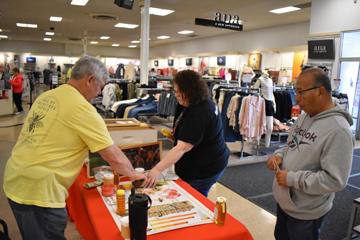
In May, children will learn how to craft a flower bouquet for Mother’s Day, which is the following day.
The April Kids Zone featured the activity of making a bee or frog magnet.
But that was before Dan Keesee had a chance to preach the gospel of beekeeping.
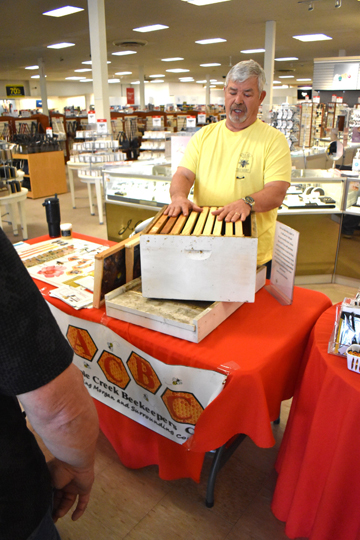
Keesee, who lives just north of Jacksonville, has 10 hives in several locations and knows a lot about bees and keeping them.
And before we get too deep into this, yes, he has gotten stung. So much, in fact, that he hardly notices it on his hands or arms anymore.
The face, though … and ears … those stings aren’t fun.
It’s not that Keesee is a careless person. He has the suit and the headgear, which is known as a veil.
It’s just that the suit, even though it’s ventilated, can be stifling. And he knows his bees well enough that he can tell when they’re docile and when they, uh, can be provoked.
They don’t like to be provoked.
He told a story about one time when he was feeding the bees in two of his hives — without wearing any of the gear. The first one went fine but he said when he placed the second jug into the second hive, “I must have crushed one.”
Because they came for him. So, he put distance between him and the hive. Not enough.
So, he put even more distance — about a hundred yards each time. Even in his truck, with the windows rolled up, still some followed him. Persistent. They had to avenge the loss of their comrade.
And they did. So many stings — half a dozen or so — to the face that his lips swelled to the point that he had to cancel going to church that day, where he was going to be on the altar, not just in a pew.
But that’s not the norm. When one understands bee behavior, he says, the risk generally is minimal. Bees have personalities — African bees are the most aggressive, and most people prefer to work with Italian and German bees because they are the most easygoing.
There’s a lot to know about bees, and Keesee knows a lot.
Asking him how he has come to know so much, one would think he has been doing this for decades. But he confesses to being a relative newcomer to the bee business, only having had hives for about eight years.
And he has learned a lot, by necessity and out of passion, in that time.
But this isn’t his first bee rodeo.
His grandfather kept bees, and Keesee learned the ropes as a child when his family was living with his grandparents.
“I never should have given it up,” he says with a note of wistfulness for the time lost in a hobby he clearly cares deeply about. But he says life came along and turned him away from bees until about retirement. He is from Streator and worked for Owens-Illinois, coming to Jacksonville in the late ’90s and eventually taking a job with Verizon.
He’s now an officer in the Apple Creek Beekeepers Club of Jacksonville. There are almost 30 members in the club, and they meet monthly at the U of I Extension office by the Morgan County Fairgrounds.
In talking with him, he drops bee knowledge almost without meaning to do so.
Here’s one: Almost all the bees one sees are female, unless one knows what to look for and when.
Maybe you know that one.
But did you know that the whole hive collapse stuff is a lot more complex than what you have read about?
He says that beekeepers are surveyed regularly about the number of hives they have at the beginning and end of each period, and the health of the bees, and how many, and so on. And parasites and other factors are definitely causing a significant decrease in the bee population. But, he says, that’s only part of the story and not a true representation of the overall picture.
Hives grow and have a lifespan. When a hive reaches the maximum population or reaches the end of its lifespan, several things can happen. Either a queen will take a portion of the bees with her to form a new hive, or a group will break off and create a new queen.
These bees leave a box hive and go, say, find a tree or something and establish themselves in a new place — one that no longer is part of a beekeeper’s hooch. These feral hives are no longer a part of the counted, monitored bee population. And they’re everywhere and they’re thriving. So the collapse is not fake news, but it’s not the total story.
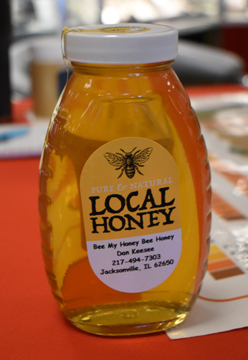
Here’s another one that Keesee proselytizes about: Local honey has health benefits that help build immunity for a range of maladies. But if all one cares about is adding some honey to sweeten a recipe, that person could simply go to a store and buy a jar of honey produced in South America, for example, because local honey is typically more expensive.
But of course he thinks you should care about the beneficial properties of local honey and supporting local beekeepers, and not just because he bottles and sells it.
He’ll also tell you that jar honey, even the local kind, is a new phenomenon. When he was with his grandfather, most honey commonly was comb honey, broken off from the actual hive. The beeswax, he says, is edible, having a chewing-gum texture, and that’s how people got their honey.
Nothing wrong with jars; just a modern, mass-production convenience.
Also, the different types of blossoms or flowers on which bees feed affects the taste of the honey they produce.
And here’s one for trivia night: Two-thirds of all the fruits and vegetables humans on earth eat need bees to do their pollination thing for us to be able to eat them.
Yes, two-thirds. In California, producers transport hives from the almond fields to the avocado fields to orchards — strawberries, pistachios, grapes, carrots — to make sure the bees are where they need to be.
Keesee told a supporting story — much smaller scale — about the year a neighbor removed trees, which removed bee habitat, which meant Keesee’s garden was off that year.
Another thing Keesee keeps coming back to is faith. He doesn’t know how anyone can look at the specificity of bees — their roles, their lives, their hive activity, self sufficiency — and not believe in God. “Where does this come from? It had to come from a higher power,” he shares.
But deep thoughts aside, he keeps perspective.
“It’s a hobby,” he says. One from which he receives immense pleasure, and one that keeps him busy.
Someone interested in getting started can get a hive from a farm supply store for about $250 and be ready to go. There’s also a community; membership in the local associations can tip people to equipment and tools that have been donated or are available for a comparatively nominal charge.
Maybe the religious aspect explains why beekeepers seem to be bent on bearing witness and bringing more people into the church of beekeeping.
The Apple Creek Beekeepers Club meets at 6:30 p.m. on the third Thursday of each month at the Extension office, 104 N. Westgate Ave., Jacksonville.
Keesee also will be making a presentation to the Franklin High School FFA on May 20, in hopes that he can demonstrate to these future farmers the future benefits keeping bees can have on their crops.
