



Construction of downtown icon had many starts and stops
By Chad Boehlke
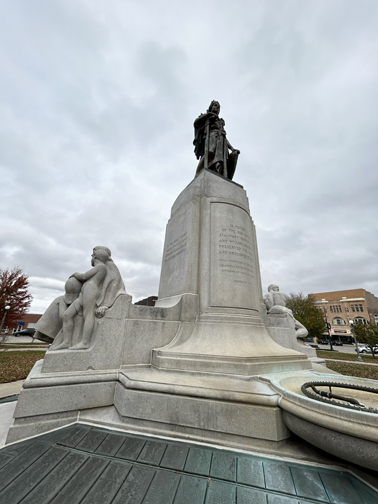
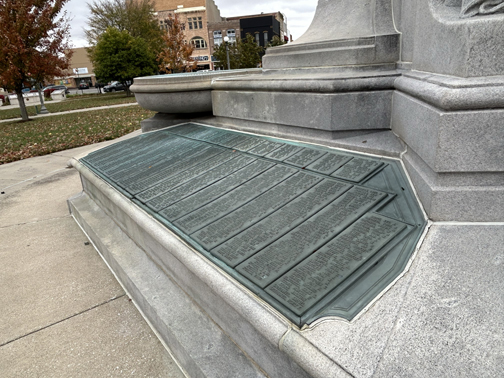
It contains about 3,316 names on four large panels along the base, with three large statues watching the square. It goes by many names — the Monument on the Square, the Statutes, the Civil War Memorial, and the War Dead Memorial.
The official name of the impressive memorial is the Soldiers and Sailors Monument of Morgan County, and it is dedicated to Morgan County’s Civil War veterans.
This monument is a testament to the bravery and sacrifice of our Civil War veterans, a place of reverence and respect for their memory, instilling a deep sense of respect and reverence in all who visit. The idea of this Civil War memorial came from the local Civil War veterans’ organization — the Matt Starr Post of the Grand Army of the Republic. Due to delays, building the Soldiers and Sailors Monument on the Jacksonville square took four years. By the time the memorial was finished, many of the veterans had died, and Matt Starr Post also no longer existed.
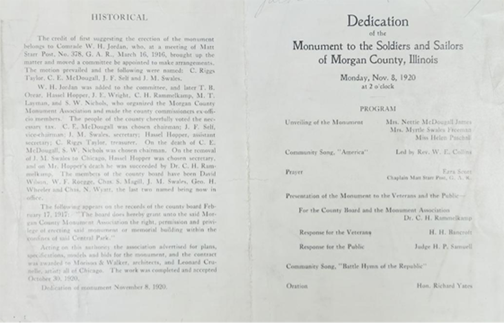
It was in early 1916 when the Matt Starr Post of the Grand Army of the Republic was formed, and its first meeting was held at the courthouse. The executive committee, led by chairman Major C. E. McDougall and secretary J. M. Swales, was determined to see the monument to completion. Even after their untimely deaths, the organization continued its work, with Dr. Charles H. Rammelkamp taking over as secretary and Sam Nichols as chairman. The news of the future monument reached svarious monument firms across America, who sent letters of interest to the organization. The local community’s active involvement and support were crucial in overcoming the various challenges during the monument’s construction, fostering a sense of belonging and pride in the community.
With the consent of the design, the City of Jacksonville, in May of 1917, approved the Morgan County Monument Association to build in the center of Central Park. The association published the specifications of the monument in the local newspaper. It included a bronze figure and tablets that listed veterans’ names. The total cost would not exceed $31,000 ($761,000 today), including removing a band shelter where the monument would be in Nichols Park.
The money raised came from county taxes. Design submissions, including plaster models and drawings, were accepted anonymously. The State Art Commission of Illinois selected three top submissions, and the Morgan County Monument Association chose the final proposal. The Illinois State Art Commission would approve all statuary.
Contractors worked with both the Morgan County Monument Association and Morgan County Commissioners. The August association meeting debated the materials used in the monument. The two choices were concrete core with granite facings or solid granite. Solid granite was decided.
In January 1918, the county commissioners delayed the project. This upset the local Civil War veterans because the commissioners gave no reason for the delay even after the Matt Starr Post passed a resolution stating that they were working against the people’s will. The February meeting revealed the reason for the delay.
By February, the selection of the monument’s builder became a source of controversy. The Morgan County Monument Association decided that Crunell, Morrison, and Walker “won” the bid with their design. However, the county commissioners favored Jacksonville Monument Company.
W. N. Hairgrove, a local lawyer, advised the county commissioners that they had the sole authority to pick the winner, causing an uproar in the Jacksonville community, with the Morgan County Monument Association and with the Civil War Veterans. Despite the initial decision, Crunell, Morrison, and Walker ultimately received the bid after much debate and sway.
At the 1918 August meeting of the association, it was announced that names would be collected and placed on bronze tablets. A debate about whose names were on the tablet became the sticking point.
It was finally decided that any Civil War veteran who lived in Morgan County and identified as a citizen could be added. Included in the meeting, the monument was to have four figures. “Patriotism,” a man drawing a sword, and “Sacrifice,” a mother holding her young son. The other two figures were not mentioned at that meeting; perhaps the two water fountains today replaced those two figures.
The year 1919 brought both delays and excitement to the monument project. In May, the Lorado Taft Studio accepted the bid to make the central figure, “Columbia.” Lorado Taft Studio artist Leonard Crenelle created “Columbia,” and the American Bronze Company of Chicago cast all the bronze for the monument. The company was best known for producing cemetery and Civil War monuments for Union and Confederacy veterans’ organizations.
The construction of the monument was not without its challenges and delays. A letter from Stone Mountain Granite Corporation in Stone Mountain, Georgia, stated they were having labor issues and delays. Still, they reassured the association that the granite was quarried, and a shipment was expected in August 1919.
However, due to design changes and a building inspector’s refusal to pass the concrete foundation as sound, Simeon Fernandes, the Jacksonville contractor for the monument’s foundation, was asked when he could begin to pour the foundation. He replied that, “[if] the contractor had been left alone, the monument would have been built two years ago.”
The goal was to have the Soldiers and Sailors Monument dedicated on May 30, 1920 — Decoration Day. However, it was not until March that Fernandes built the monument’s foundation, and the contractor who assembled the monument statues, George Archer, was out of town until October.
To top off the Morgan County Monument Association’s troubles, the weather was cold, wet and windy, and the monument’s unveiling was moved indoors to Centenary United Methodist Church on East State Street.
Today, the Soldiers and Sailors Monument of Morgan County symbolizes reverence and respect for the local community. Columbia, the central figure, sits on top, looking south at the directions the men went to fight the war. The other granite statues represent the sacrifices and bravery of the local community during the war. Sacrifice, facing the west, represents the mothers who gave up their boys to fight the war, and Patriotism, facing the east, is a powerful symbol of the community’s proud response to the call to arms. An unexpected panel of names was added on the east side in November of 1920 to fix spelling mistakes and names that did not make the deadline.
The Soldiers and Sailors Monument of Morgan County lists thousands of names, but not all our local Civil War veterans’ names are listed. Among the missing are local African Americans who served in the war. While the monument stands as a powerful tribute to the sacrifices of the local community during the Civil War, it is essential to recognize its limitations in fully representing the diverse and complex history of the Civil War.
