
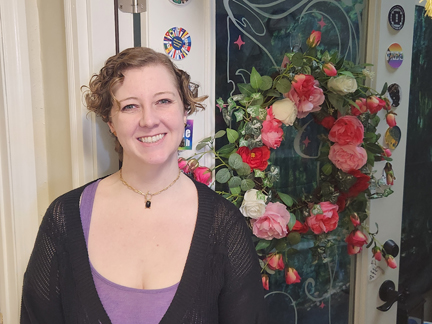
Locust Street ‘Living Room’ helping to address mental health needs in Jacksonville
By Ben Cox
“I’ve been there — that’s why I’m here,” is a part of a refrain of a 1998 hit country song by Kenny Chesney that talks about a person in alcohol counseling finding hope through empathy and eventual recovery. The story of that song is currently played out every day in Jacksonville at Locust Street Resource Center.
Locust Street opened at 60 East Central Park Plz. on July 5, 2023, filling the spot that was formerly the home of Community Hope & Recovery, a separate counseling service. Locust Street’s Jacksonville branch is the fifth office in the group’s history. Locust Street Resource Center began operations in August 1974 as Macoupin County Mental Health Center, for the purpose of providing mental health services to adults and children in Macoupin County. They now have offices throughout West Central Illinois.
The Jacksonville branch offers a unique, but smaller take than their Carlinville offices. One of those unique experiences is The Living Room Crisis Diversion Program that launched in early June 2024. Recovery support specialist Jada Lutzke operates The Living Room for approximately 5-6 clients per week.

The Living Room Crisis Diversion Program is funded by the Illinois Department of Human Services. It began as an experiment in Skokie in 2013 and has quickly expanded to several locations across the state. Locust Street currently is the only provider for the program in West Central Illinois.
The Living Room Program is for individuals 18 years of age or older in need of a crisis respite program with services and supports designed to proactively divert crises and break the cycle of psychiatric hospitalization. Lutzke says there is a loose definition of what ‘crisis’ is for The Living Room, as they never turn anyone away from whatever they are experiencing: “I’ve had people [where] their spouse just died or they are having a hard time in their [personal] relationship with someone and they need a sounding board or [they] just need to get off their chest what’s going on with them.”
Lutzke says it doesn’t necessarily begin or end with an interpersonal relationship crisis: “I’ve had other people who’ve gotten scary diagnoses like terminal cancer. It’s really whatever that person needs at that moment.”
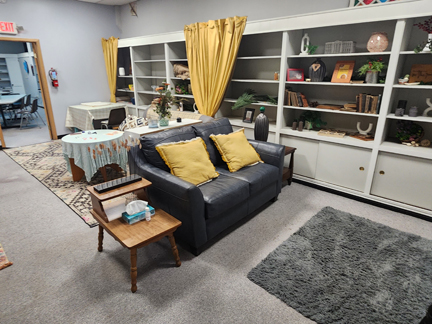
The Living Room Program provides a safe, inviting, home-like atmosphere where individuals can calmly process the crisis event, as well as learn and apply wellness strategies which may prevent future crisis events. “The purpose of it is to have a safe, calm place that is accessible to people who are experiencing a crisis — a mental health crisis, “ Lutzke said as she opened the door to a calm, naturally lit space adorned with affirmation knick-knacks and soothing colors.
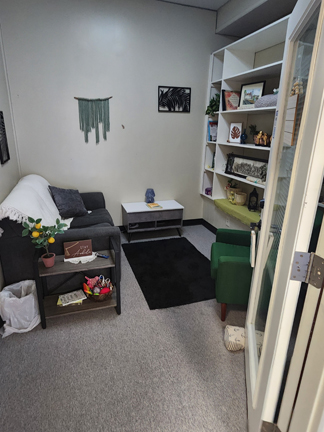
She added, “One of the big things about it is that it’s non-clinical. It’s supposed to look like you are walking into a living room.”
As a recovery support specialist, Lutzke is able to relate to her clients with her own lived experience as she is in recovery of a co-occurring mental health crisis and substance abuse. The Indiana native originally started out in anthropology but after a stint in rehab for alcohol abuse as well as previously dealing with mental health, she wanted to help others. While in recovery, Lutzke says she saw a job posting as a recovery specialist and applied, despite not having a certificate or background in social work, psychology or psychiatry. She soon got connected to a PRSS/CRSS year-long program and completed it. Part of her apprenticeship for the program is running The Living Room.
Lutzke has now made it her mission to help those who have been or currently are in recovery or are dealing with a crisis. “That’s kind of part of the specialty here is that you are going to have people that understand and we want to be able to connect. It’s hard to talk to people who don’t understand,” Lutzke relates, “We want to be able to make connections so those people don’t feel so alone. Having that community and that hope that things can get better. I can help you because I’ve been there and I know how you are feeling. There is a lot of compassion and empathy from those that work here and those that come in here.” Lutzke isn’t afraid to meet with some clients outside of the center if need be, just to give them a chance to vent or share if they are experiencing a crisis.
According to the National Institutes of Health, 65% of nonmetropolitan areas in the U.S. do not have a psychiatrist available and over 60% of rural Americans live in designated mental health provider shortage areas. Results from the 2023 National Survey on Drug Use & Health, 7.7 million nonmetropolitan adults reported having any mental illness in 2023. The gap in services is even worse for the unhoused and working poor.
Locus Street hopes to eventually expand its services beyond its normal counseling services that it provides, including group services being held more than once a week and mobile crisis intervention.
Meanwhile, Lutzke is trying to connect with the community more. She recently joined the Rotary Club of Jacksonville. She is planning on pulling in a group of volunteer Rotarians to put together care bags full of personal hygiene products. Lutzke currently has a group of donated items running from adult clothing to hygiene products that she has purchased on her own or received via donations for some of the underprivileged and homeless clients that come to the center. She also works to connect some clients to services beyond the center including to the Morgan County Housing Authority, New Directions Warming & Cooling Center, the Phoenix Center, 6th Street Resource Center or Family Guidance. Lutzke recently received a donation of coats from the Phoenix Center that double as sleeping bags for those who are unhoused and have no inside shelter. She says she’s also helped arrange for some to receive travel out of Jacksonville, if that’s what they are seeking. She says these are the needs that go beyond The Living Room, but it’s all an attempt to get support to those who need it.
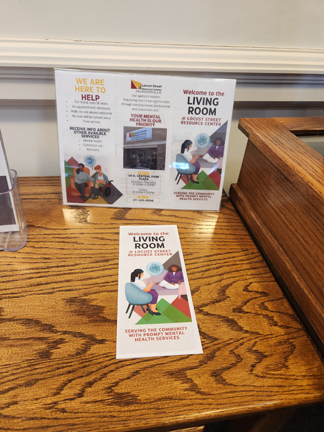
The Living Room Crisis Diversion Program at Locust Street Resource Center is open Monday-Thursday 8:30 a.m.-4:30 p.m., and Fridays 8:30 a.m.-4 p.m. The service is completely free. Walk-ins are welcome. No one will be turned away. No appointment is necessary. For more information, call 217-505-0099 or visit locuststreetresourcecenter.org.
