
The Esprit de Corps Academy hosts open house to show community what they are all about
By Marcel Pacatte
Photos/Marcel Pacatte
If you’re looking for the animating principle — the “why” — of The Esprit de Corps Academy, Jacksonville’s music education and performance academy that is committed to connecting local youth with the possibility that comes from the arts, try this:
Talent is everywhere. Access is not.
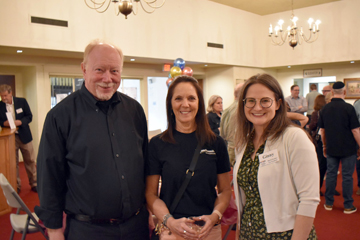
That’s straight from Tim Smith, the academy’s president, who was beaming last Thursday night as he welcomed supporters, students, teachers, board members, dignitaries, the curious and many community members to the academy’s new space at the southwest corner of Church and State streets.
Access.
That’s what Rabbi Rob Thomas and his wife, Lauren Thomas, are providing to The Esprit de Corps Academy in having purchased the former Grace United Methodist Church building and subsequently turning it over to the academy for use as a teaching, learning and performance center.
But that’s been in the news.
What Jacksonville got a taste of the evening of Thursday, April 9, was the possibility that comes from the Thomases’ gift.
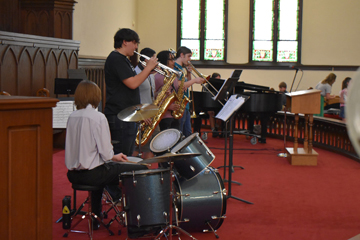
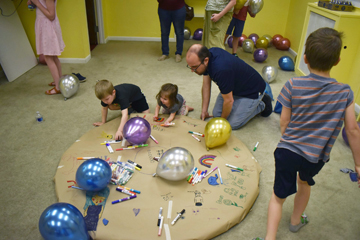
Students — young people — are singing, stamping their feet, playing instruments and expressing themselves artistically. It’s all happening in their new home, a much larger space than the one at the old MacMurray College hall, and one that now belongs to them.
Features? One, a capacious sanctuary that has seating galore and an expansive stage. Two, a warren of rooms wrapped around that central space on at least three levels, once used for Sunday school instruction, now for practice and lessons. And, three, pianos. Plenty of pianos.
Smith noted that the academy welcomes donations of old instruments but that they are fine on pianos. In fact, what they’ll soon be needing, he said Thursday evening, are piano teachers, to match the talent with the access as one of the teachers prepares to graduate from Illinois College, leaving almost two dozen students in need of instruction.
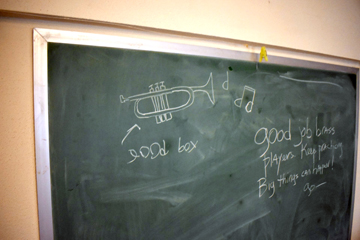
Smith told those gathered on Thursday that too many kids never get the opportunity — the opportunity to try the French horn or oboe or trumpet or drums, much less formally explore the full register of their voices, whether for gospel or opera or a simple bagatelle.
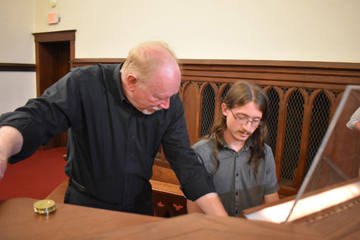
And, thanks to the Thomases, kids have the chance to tickle the ivories of a serious church pipe organ, which several did under Smith’s impromptu tutelage toward the end of the program Thursday.
But it’s not just about dabbling.
For the proof, we turn again to Smith:
Students involved in music, he said, do better in math, and receive higher grades across the board. They have higher-than-average graduation rates. They are shown to score 107 points higher on the SAT — that quite specific stat is from a study by the College Entrance Examination Board — and are shown to have significantly advanced reading and comprehension skills.
They do better with foreign languages. They have up to a 70% higher chance to be admitted to the college or university of their choice if they show high school credit or achievement in music.
And, Smith went on to note, music is a path to medical school: Fully two-thirds of med students have a background with instrumental or vocal music.
Drugs? Alcohol? Tobacco? Students who have participated in music have the lowest levels of current and lifelong use of them.
Increased memory skills, critical thinking, physical coordination? It all is enhanced by experience with music.
Another benefit, Smith said, is that musical exposure helps students develop responsibility and deepens understanding of history and culture.
And as if all of that weren’t enough to persuade a student or a parent to sign up, Smith closed his citations with this:
“Finally, it is fun!”
Proof?
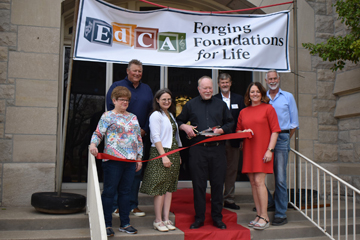
At the ribbon cutting that kicked off the program — on the steps outside, just off the red carpet — Smith used Oliver Wesley Stubblefield’s sword to commit an act of sabrage on a celebratory bottle of champagne.
In other words, Smith thwacked at the cork with the blade until the cork popped, and he exultantly brandished both.
How many ribbon cuttings has the Jacksonville Area Chamber of Commerce had that feature an antique weapon from the great-great-grandfather of academy board member Ginny Walsh, much less a bottle of bubbly?
Now, this is all great on paper, but who can afford to participate in what The Esprit de Corps Academy offers? Bassoons, after all, aren’t cheap — much less engaging the services of a bassoonist to show you how to get something other than squeaks out of it.
That’s probably the best part: The Esprit de Corps Academy does all of this at no cost to the students.
Access.
That’s just one reason Smith and everyone involved with the academy is so grateful to the Thomases for their gift.
“The gift of this facility is a transformational, founding act,” Smith said. “We began teaching three years ago and have grown to 150 students. Our new home will enable us to better educate current students, create space for new students and to become an arts center far beyond our original vision.”
Smith described being asked to meet with Rabbi Rob Thomas, not knowing what Thomas had in mind.
“This facility was an unexpected gift and a validation of our purpose,” Smith said. “This facility will ensure that arts education in Jacksonville will continue into the future, and establishes Esprit de Corps as a serious, legacy-worthy institution.”
Anyone interested in becoming involved, whether by learning, teaching, attending a performance, receiving a tour or donating, is asked to contact the academy via TheEspritdeCorpsAcademy@gmail.com or 361-244-4001. The mailing address is: The Esprit de Corps Academy, Attention Tim Smith, P.O. Box 12, Jacksonville, Illinois 62651. The street address is 400 W. Morgan St., with the entrance facing Church Street.
The academy has programs in instrumental music, vocal training and choir, theater and stage performance, ensemble collaboration and public performance and showcases.
The instructors, Smith said, combine professional expertise with a passion for mentorship, guiding students to unlocking their full potential.
And, he said, in addition to the fun factor, there’s the exposure the fine arts brings — to lifelong joy.
