

As a youth in the 1940s, winning the Soap Box Derby was dream
By David Blanchette
Photos/David Blanchette
It was all over in 30 seconds. “As I traveled down the ramp, I moved my body so maybe it would gain a little bit of momentum. We hit the pavement and I traveled side by side with the other competitor,” said Fred Engelbach.
“I wanted to edge my car over to the curb because the curb was a little bit lower and you could possibly gain a little speed by the end of the race.”
The 88-year-old Engelbach was recounting the 1946 Soap Box Derby race in Jacksonville, a annual contest in which he first competed at age 11.
The race was on West College Avenue across from Illinois College, and the home-built race cars started on a ten-foot-high platform built by local craftsmen. The cars were carried to the top of the platform, and the young racers climbed into their wheeled creations.
“There were two cars side by side, there was a board laterally across the structure and the cars were nosed into that board,” Engelbach said. “When the board hinged down, we rolled down the ramp and the race started. We were off!”
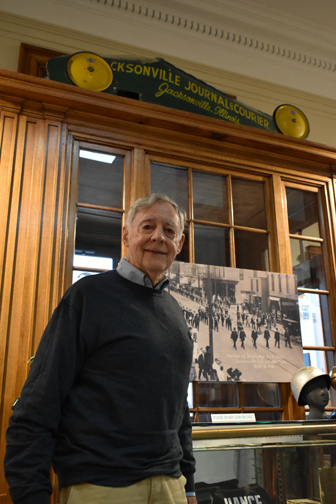
There were two divisions in the Soap Box Derby, Class B for 11 and 12-year-old boys and Class A for boys ages 13 through 15. Engelbach was a Soap Box Derby rookie and did quite well.
“I was a little bit surprised that I kept winning in my division. There were three or four heats and in each heat I was the winner,” Engelbach said. “I was the winner of Class B and had to compete against the Class A winner for the Derby title.”
Before describing that pivotal final race of 1946, a little bit of back story about Engelbach and the Jacksonville Soap Box Derby.
Engelbach was born in Michigan but moved at age two with his family to Jacksonville. World War II loomed large in his early life, and his physician father, Dr. Friedrich Engelbach, served in the Pacific theater for two and a half years.
After the war, people were ready to return to more normal lives, and young people in particular were drawn to creative and competitive pursuits. One of the most well-known and popular of those pastimes for boys (and now girls as well) was the Soap Box Derby, a contest that started in 1934 and was billed as the “greatest amateur racing event in the world.” The Derby went on hiatus from 1942-1945 due to the war but returned with a vengeance in 1946. The Derby continues to this day.
“I was a little late in knowing about the Soap Box Derby. My friends got a jump on it, they started building their cars and I got interested and felt that I wanted to do that too,” Fred Engelbach said. “At age 11, a Derby car is something a kid dreams about having, a car with a steering wheel and a brake and you could roll down the hill in it. That appealed to me.”
The Soap Box Derby concept is simple. Competitors build their own gravity-propelled race cars using some common supplied components, like the wheels. One of the major rules is that the combined weight of the car and driver cannot exceed a certain amount – heavier car/driver combinations have an advantage over lighter ones in a gravity-powered contest.
“I was a slender youth and most of the racers were heavier than I was,” Engelbach said. “I was concerned they would have the jump on me because the weight of the car and the driver exceeded me and they would get more momentum going down the ramp.”
Engelbach’s father had an idea to even up that weight differential. He came up with a secret component to add to the wood-and-canvas-covered, home-built race car.
“My father had an idea to build the base of the car with heavy timbers and he was aware that a bridge near Arenzville was under repair and they had removed the planks from the bridge,” Engelbach said. “He made the arrangement to have enough of those planks donated to build the base of a car. That did a lot to solve the weight problem because they were oak planks, two-and-a-half inches thick.”
“There were two suppliers of the wheels and axles, the Firestone Company and the Goodyear Company. The other kids and I had a lot of discussion about whether one company’s wheels and axles were better than the other.” Engelbach said. “That was an inconclusive discussion because they both looked the same except they were painted different colors. My wheels were yellow from the Firestone Company.”
The car’s steering wheel was connected to the ends of the axles by a drum with rope or cables. The brake looked like “an old Volkswagen emergency brake, you would pull up one end and the other end would press down on the pavement and create friction,” Engelbach said. “It was about as simple as you could be. Remember we were just young kids and it couldn’t be too complicated.”
Engelbach tested his green-painted car on hilly city streets, and then was ready for race day. As noted before, the Soap Box Derby newcomer did well and won the Class B competition. That put Engelbach in the final race against the Class A winner, Bruce Samoore.
“Much of my recollection of that race comes through photographs that were taken and I remember myself as I appeared in those photographs,” Engelbach said. “It was a pretty close race but Bruce [Samoore] won. He got out of his car and we shook hands.”
Samoore went on to compete at the national Soap Box Derby finals in Akron, Ohio. He didn’t win there, but Samoore’s original Soap Box Derby car and his 1946 Jacksonville race trophy can now be seen at the Jacksonville Area Museum.
Meanwhile, Engelbach competed two more years in the Jacksonville Soap Box Derby but never matched the success of his rookie year. He lived in Jacksonville until college, became a U.S. Air Force civil engineer for 26 years, worked for two decades for the New Hampshire school system, and retired and lives in Portsmouth, New Hampshire with wife.
Although he hasn’t lived in Jacksonville for years, Engelbach will always remember his home town and the Soap Box Derby.
“Jacksonville was a very positive, supporting community as evidenced by the Soap Box Derby. In the 1940s and 1950s the town would turn out for those races in the thousands,” Engelbach said. “The street was fully lined with people. That’s typical of growing up in Jacksonville and having the support of a community and people that cared for kids.”
