
By Patsy Kelly
We humans are highly developed creatures, with extraordinary capabilities. One of these is the mind. We rely heavily on our reasoning capacity, with good cause. We can problem-solve, analyze, and sort through varieties of information, to find clarity in confusing times. The only flaw our minds have is assuming they are superior to all other functions.
Reason supplies all manner of facts and evidence; but our body never lies. Enter grief. This is one episode in our lives in which reason must often take a back seat. We tell ourselves one month, or two months after losing our loved one, we need to ‘get it together.’ We might even argue in another year we must ‘face reality.’ Even friends and family members may begin to hint – “Aren’t you taking this a little too far?”
The problem is that there is no timeline for grief; we cannot schedule, push, delay, or put it on a shelf until a more convenient time. Grief enters our life and insists on being heard. It is not a rational force that has entered our lives and will not be dealt with by rational means. Grief tears our hearts open and demands we feel. There is no step-by-step script for us to follow. In fact, our minds may interrupt, making demands that we find ‘meaning’ in our grief, or ‘make sense’ of our feelings.
Ironically, grief is a “graduate school” outside of rational processes. The painful work of grief opens us up to accept the searing agony of the loss without trying to make sense or fix or solve the puzzle. It is a searing loss of the one who had died as well as the loss of the person we once were when that person was alive. All the old securities are shredded, like paper that flies away in a gust of wind. We are lost and can’t function in the old ways; we don’t think clearly. We flounder and can’t find our bearings. We try to intellectualize but can’t. We can’t because there is no rational means through this mystery called grief. It is bewildering and we can feel as though we have lost our moorings. And that is okay.
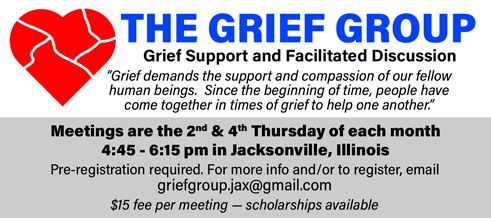
Writer and grief counselor, Stephen Levine, calls grief, “the unfolding of magnificent complexity and almost unbearable simplicity in a strange sort of way” (Meetings at the Edge, “Dialogues with the Grieving and the Dying,” Stephen Levine 1984). As we learn less and trust ourselves more, there is a gradual opening within to the work grief invites us to undertake. We allow ourselves to explore without requiring answers. We willingly enter periods of sheer emptiness without expecting a solution. We let go of our expectations, limitations, self-judgments; and we accept our pain with kindness and compassion. We find we are able to respond to life with a new wholeness and balance of mind, body, and spirit. We expand into becoming persons of greater capacity to live, love and to persevere. For more information, send an email to: griefgroup.jax@gmail.com. Scholarships available.
