
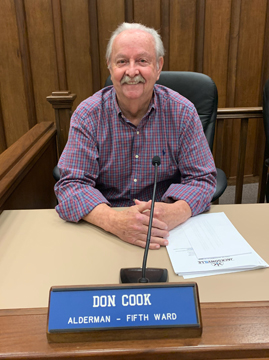
Retiring after decades, Don Cook celebrates his time as Jacksonville police officer, chief and alderman
By Ben Cox
Photos/Ben Cox and Submitted to The Source
When Don Cook was sworn in as a Jacksonville police officer in June of 1970, he already knew exactly where he wanted to end up.
Sitting in the office of then police chief Charles Runkel, Cook was asked a simple question on his first day: What’s your goal here? His answer—half bold ambition, half young officer bravado—came quickly.
“I told him I was going to take his seat,” Cook recalls with a laugh during a January interview with The Source. “[Runkel] said, ‘That’s pretty bold.’ I said, ‘Well, you asked me.’”
More than five decades later, that moment feels less like bravado and more like prophecy.
After 54 years serving Jacksonville, as a police officer, detective, police chief and ultimately as Ward 5 alderman, Don Cook officially retired on January 31, closing one of the longest chapters of public service in the city’s history.
From Jacksonville to Vietnam—and back again
Cook’s path to law enforcement began close to home. A Jacksonville native, he graduated from high school and enrolled at Southern Illinois University. That path was interrupted when he was drafted into the military and sent to Vietnam, serving from 1967 to 1968.
When he returned, Cook resumed classes—this time at SIU Edwardsville—but the transition from combat zones to windowless classrooms proved difficult.
“I just wasn’t ready for it,” he says. “After being out in the field for two years, sitting in a classroom with a desk, a chalkboard, and a clock—I knew it wasn’t for me at that moment.”
Back home in Jacksonville, a conversation with his brother, who was on the fire department, changed everything. The police department was testing, and Cook decided to give it a shot.
That decision would shape the next half century of his life.
Learning the streets—and the job
Jacksonville in 1970 was a very different city. It was a burgeoning industrial hub and was around its peak population of approximately 21,000 people. The police department was smaller, training was informal and technology was nearly nonexistent by today’s standards.
“There weren’t even training officers back then,” Cook says. “But there were some great characters who broke me in.”
After three years on the street, Cook was selected to attend the first field training officer class in the State of Illinois, which was held at the University of Illinois. When he returned, he became responsible for training new officers—work that would define much of his career.
Over time, Cook was promoted through the ranks, eventually becoming a sergeant in the 1980s and later taking on leadership roles that expanded beyond patrol work.
Homicides, drugs and a changing city
Over the decades, Cook worked countless cases—many of them unforgettable.
His first homicide investigation occurred on Fayette Court, involving two men in an argument, over a girlfriend, that turned deadly. Cook secured a spontaneous confession, quickly bringing the case to a close.
As his career progressed, he worked numerous homicide and drug cases, particularly after becoming chief of detectives. Each case reflected a city changing in both size and complexity.
“It was primitive back then compared to now,” Cook says. “Everything was done by hand. If you wanted to look up a license plate, you were digging through cards. Messages went over old teletype machines.”
Despite the limitations, Cook and his colleagues built investigative processes that would later become models for other departments.
Building the detective division
When Wilbur Stafford became police chief, he tasked Cook, then a lieutenant and shift commander, with creating a formal investigative section within the department.
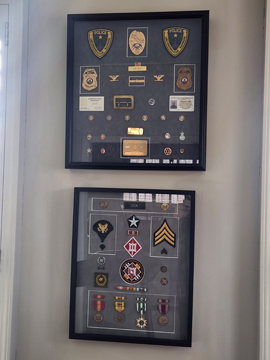
Cook built what is now the Jacksonville Police Department’s detective division, working alongside officers such as Reggie Cummins, Willie Brown, Paul Watkins, Chris McMinn, Michael Meyer and others, including a future U.S. Secret Service agent, Therron Hess.
The division gained enough recognition that officers from surrounding counties, including Greene and Cass, visited Jacksonville to learn how the unit was structured and operated.
“It was a look-and-see kind of thing,” Cook says. “Smaller departments didn’t have investigative sections like that.”
An international experience
One of the most unique chapters of Cook’s career came in 1979, when he and then officer Neil Snelling traveled to England as part of an exchange program inspired by an FBI Law Enforcement Bulletin article written by Chief Stafford.
Stationed in Durham, north of London, Cook worked alongside British police officers across multiple divisions, gaining firsthand experience with a vastly different policing system.
The experience included appearances on BBC television and travel throughout the country. The exchange program continued annually for several years and remains one of Cook’s most cherished memories.
“It was a great experience,” he says. “We met incredible officers—from the top to the bottom.”
From police chief to city hall
After retiring from the police department, Cook’s public service didn’t end. He later served 14 years as Morgan County Ward 5 alderman, bringing his law enforcement background and institutional knowledge to the city council chambers.
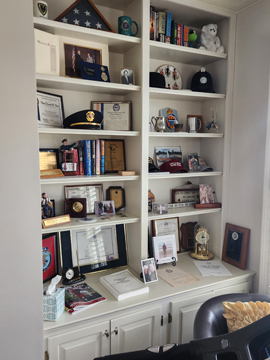
Cook served as longtime chair of the city’s finance committee, overseeing major projects like the Downtown Turnaround and the current utility department upgrades. Cook says he’s had a chance to work with some great people at the Jacksonville Municipal Building. He credits board members, past and present, for getting things done for the betterment of the city.
“We didn’t always see eye to eye, but we could always work toward the objective of doing what’s best for the city,” Cook recalls.
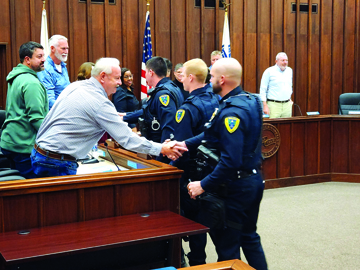
At his final Jacksonville City Council meeting on January 26, Cook explained his decision to step down simply.
“It’s been 54 years,” he told WLDS News. “I’ve served the citizens of Jacksonville, and Pat and I decided we’d like a little more family time than what we’ve had. I really don’t want a schedule anymore.”
Cook says that his wife, Pat, should be thanked for the sacrifices that she and the family made over the last half century while he dedicated his career to the city. Cook says he has plans to travel, play more golf and spend more time with his children and grandchildren.
When asked about his replacement, Cook deferred to City of Jacksonville Mayor Andy Ezard, emphasizing the importance of the process rather than personalities.
A career defined by commitment
From a young patrolman with big aspirations to a veteran public servant whose fingerprints are all over Jacksonville’s modern policing structure, Don Cook’s career has been defined by commitment—to the job, to the city and to the people he served.
As he steps away from public office, Cook leaves behind more than titles or years of service. He leaves a legacy built on mentorship, innovation and a deep belief in serving the community he never truly left.
For Jacksonville, Don Cook wasn’t just part of the city’s history—he helped write it for the last half century.
