
Fundamentals are at the root of Joe Kindred’s Rocks Baseball Club
By Marcel Pacatte
Photos/Special to The Source
A good carpenter needs to be precise and dextrous, strong, deliberate in taking measurements, knowledgable of which tools are needed in specific situations and qualified with good eye-hand coordination.
Those traits dovetail with those of a good pitcher, who has to be in command, have control and focus, mental fortitude, consistent delivery and able to put a batter on his heels as the pitcher works the edges of the strike zone.
And then there’s the 8-year-old.
The needs there are simpler. The French philosopher Voltaire is said to have mischievously attributed to St. Ignatius Loyola the notion that character is shaped early — “Give me the boy and I’ll show you the man.”
Joe Kindred isn’t especially interested in the snickers of 18th century French philosophers or the particulars of 17th century Jesuits, but that shape-a-kid-into-a-man stuff has him perk up. It’s pretty much his motto at Rocks Baseball Club.
Right there with him is Gary Nickels, a scout for major league baseball teams for 50 years, now retired, who says the fundamentals at that age are basic: Eight-year-olds need to learn how to play catch. They need to learn how to be a member of a team, a part of a group effort. They need to learn how to understand the game of baseball.
And they also need to have fun.
“You have to get them to enjoy being involved in the game,” Nickels says of the 8-year-olds.
The carpenter, the pitcher, the 8-year-old, Kindred and the major league scout.
Nickels is the common element here. In the early years of his scouting career, he was with his wife visiting his in-laws when across the street he saw a kid, an 8-year-old, tossing a ball.
Nickels crossed the street. Played catch. Showed the kid a couple of things. Here, kid, is a thing called the forkball, he had explained to that child.
The forkball came from ElRoy Face, relief pitcher for the Pittsburgh Pirates and a few other teams. He was a carpenter in the off-season and took up the trade full time in retirement from the big leagues.
So, now we know what carpenters and pitchers have to do with Nickels, the king of the major league baseball scouts, and that Nickels once showed an 8-year-old a fancy pitch that had revolutionized baseball.
That ties most of this together.
But what does ElRoy Face’s splitter have to do with this story? If you haven’t guessed, it’s Kindred.
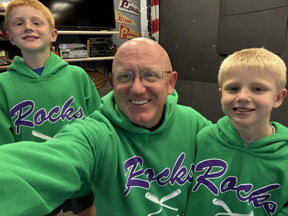
Joe Kindred is pictured in Rocks Baseball Club gear with sons Brody, left, and Mason, right.
Meet Joe Kindred.
Kindred lived across the street from Nickels’ in-laws and was eight years old when Nickels had showed him the fork. Kindred was that kid.
Kindred credits the time Nickels, then a scout with the Philadelphia Phillies, took on that fateful afternoon with the through line that gets us from Waverly’s State Street to Jacksonville and the Rocks Baseball Club that Kindred has started … for 8-year-olds, and those a couple of candles on cakes in either direction.
Kindred’s belief is that kids need exposure to skill development, to the fundamentals of the game — playing catch, hitting, running the bases — and that they need to have fun along the way.
Because without joy there is no confidence, and without confidence there is no point.
It’s almost uncanny that Kindred and Nickels believe the same thing. They never have spoken to each other about that belief.
It’s just something both know from experience.
If you believe that good carpenters and good pitchers — and good major league scouts — are born and not made, then you probably won’t understand why Kindred is motivated to do what he is doing.
But if you believe that even good carpenters and the rest can be trained to be even better at using the talents they were born with if they are properly coached and correctly
formed, then you can begin to see, as Kindred does, that the young kids out there are blocks of wood, or marble, just waiting for the right tools and the right craftsman to sculpt them to their full potential.
But isn’t baseball over? Aren’t we in full-bore football mode now? Days are already noticeably getting shorter.
Sure, but that’s the beauty of what we’ll call the “Kindred System of the Rocks Baseball Club.”
Team absolutely is a key component, but Kindred also emphasizes the personal attention that comes from one-on-one sessions and small group skills development, and those things know no off-season, so they happen year-round. And these training sessions can be scheduled around football, golf or cross country now, and around basketball in the winter, or whatever else anyone has going whenever they have it going. Kindred is simply interested in building stronger baseball players who understand and enjoy what they’re doing on the field and who won’t be 13 years old and utterly burned out on the sport — and he knows from his years playing and coaching that stronger and happier baseball players help keep burnout at bay.
Baseball is one of the most stats-driven sports and one stat that illustrates
Kindred’s purpose is that more than 8 million kids between the ages for 6 and 18 participate in the sport. Kindred wants in early.
And here’s another stat to show why he has it right: Almost three-quarters of those who play baseball leave the sport by the time they turn 13. And why? Most say it stopped being fun for them. It’s the same reason kids stop liking math or English or just about everything else just about then: It gets harder.
Work with them, though, and you can help them bridge that period without becoming disillusioned and quitting.
Parents get it.
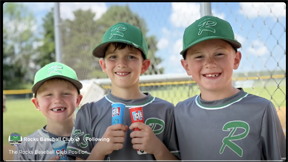
From left to right are Mason Kindred, Tucker Aring and Will Leib. Each is with Rocks Baseball Club and the three are featured in the opening of a promo video for the club.
Matt Frisch’s sons, Brody and Grayson, are under Kindred’s tutelage, and Frisch talks about how now is a hard time to raise kids but that having them exposed to the attention and experience they get through Rocks is helping them develop skills that will make them better players. He also feels it’s affordable and likes that it’s local and competitive.
Shhh. Kindred says he doesn’t want to emphasize the competition part; that will come, he says, with the focus on the skill development. It’s kind of how kids don’t immediately realize, once the training wheels are off and mom and dad stop running along behind, that they are riding the bike all by themselves for real.
Remember the elation that comes from that realization? That is exactly what Kindred hopes to tap at Rocks Baseball Club: Pedal first, balance, find confidence and then go like blazes.
Many of the parents whose children are involved in Rocks were on teams Kindred previously coached, but that’s not at all a requirement.
It’s just, as one parent and former player pointed out, they know firsthand Kindred’s passion and energy. “He’s amazing,” shared one parent.
Kindred is grateful to not only the parents but also to Future Champions Sports Complex, which lets Rocks use its facilities.
Most of the small group and individual sessions take place at Kindred’s home, which is tricked out for baseball better than many high school facilities.
“We just want to help those individuals get better at baseball. And of course softball — because we do softball training, too,” shares Kindred.
While registration for the fall skills league just closed, anyone interested in individual sessions is welcome to email Rocksbaseballclub@gmail.com, or to call or text Kindred at 217-720-6835. Small group training is offered as well. All skill levels are encouraged to participate — “But just have fun with it,” finishes Kindred.
