
By Ben Cox
Tim Greene grew up in Pike County and graduated from Pittsfield High School. Like any kid growing up in West Central Illinois, agriculture is just a part of life.
Greene spent a few summers in Arenzville detasseling corn with friends for extra money. He stayed local for college, graduating from Illinois College in Jacksonville in 1991 with his bachelor’s degree.
Greene has a gregarious personality that makes him adept with sales and customer service. He greets me with a joke and a smile. The cup of coffee on an early weekday morning also seems to kickstart my brain and the conversation. He gives me some off-record information about the location of some of the historical buildings on the campus of the Burrus Seed operation.
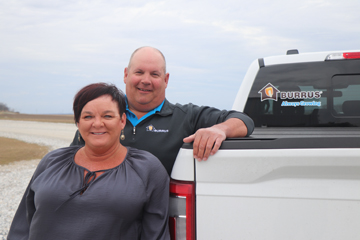
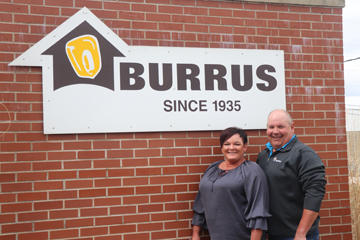
We have familiarity. There is a warmth that comes with that — something relatable and tangible. We talk about local high school football for a few moments before Todd Burrus joins us. Even in the world of the internet where sales are sometimes made by emails and text messages, Tim Greene conveys why it is still important to greet people face to face with a firm handshake, honest words and a relatable story or two. He’s the perfect compliment to Todd Burrus in our roundtable conversation about the history of his family’s business. As mentioned, Greene’s involvement with Burrus Seed began before he actually became a part of the family. His wife, Lori (Burrus) Greene, also an Illinois College graduate, is the daughter of Marcy Burrus and the late Thomas “Tom” Burrus.
Ben Cox: So, tell me where you got started at here with Burrus Seed.
Tim Greene: I started the same way the Burrus family did, detasseling corn. I grew up in Chapin, so at that time, that’s what you did. I mean, you either walked beans, bucked bales or you detasseled corn pretty much. That was my first experience of being around here at 13 as well as detasseling. It was a fun experience when you think about it, and maybe all the years cloud the memories a little bit, but no, when we visit back with friends at that time, they talk about all the good times of working with friends and it was a great learning experience as a first job really and a good experience. We have kept several kids through their college age years, too.
It’s really, really fun to reminisce, for everyone to look back on. After detasseling, I ended up graduating from Illinois College here locally. Then I worked and started out — and I really commend Todd, my father-in-law Tom and Martin for giving me that job.
I started on the production side of the business for a year. I really didn’t have much farm experience; I grew up with a family that had farms, but I was not a farm kid per se. That one year of working in production, I think, was a great stepping stone and building block so to speak, because I got to see and participate in all facets of the production part of our business from planting the crop and tending to it throughout the year, harvest, to bagging and trucking the seed. And then following that year, I joined our sales team, and that’s part of the business I’ve been involved with ever since for the last 30 plus years.
I started as a territory manager down in southern Illinois and just continually started to work my way back up here closer to home, and over time started working when Tom and Todd thought it was appropriate for me. When I started working with them, we used to have a lot of local dealers, some key customers that came in here to do business 25 plus years ago. I worked at a territory and worked out of the office, kind of sitting in on some of the meetings and family meetings and participating in that way to help build a knowledge base.
Then, Tom and I ended up making a decision, and I came into the office full time. He and I split managing the sales team and then eventually I managed our sales team for a period of time. Then, as we continued to grow, we knew we needed a general sales manager. So, I was still facilitating working with our general sales manager, some of our communications, things like that. Then, my father-in-law Tom passed away in 2017 and after that I had succeeded him in his role of president of our sales organization. That’s kind of been the arc of my career here for 34 years to date.
BC: In the last 30 plus years of this business, I’m sure you can tell me it has changed quite a bit.
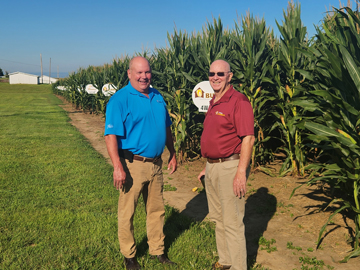
TG: There are actually. As we put together our showcase to kind of celebrate our 90 years, out in the [demonstration] field, we were actually able to recreate the very first hybrid we ever had in 1935. U.S. 13 is one of the first ones we sold, and it’s out there in the plot. As we take growers through, they can see there’s some open pollinated stuff. There’s U.S. 13 and then some of our historical top-selling products throughout the years. One of the changes is in the accelerated breeding and the way things change.
One of our biggest selling products, BX 26, we had that in our product lineup for 13 years. That’s unheard of today because the average life cycle’s under three years on a hybrid or right around there. With that rapid change, you don’t have the same product all the time because you’re always improving upon it. That’s what’s really been fascinating over the last 30 years.
Another big change is when Roundup came on the scene, causing Roundup tolerance and resistance for crops and the different seed treatments and the insect resistance traits that we can put in products today. It really helped growers in production agriculture and being more efficient for not only their own farm but for the environment. It has really been fun to be part of that, to see all that change.
BC: How has the size of the sales territory changed? Did it just start here in Cass County and then branch out? Or was it Cass, Morgan, Greene and Scott, and then branched out to different states?
TG: Originally it was Cass Morgan Seed, and then the reason there’s Burrus Brothers & Associated Growers as part of the name is back when the company officially started in 1935 and we raised our first acre of seed.
The University of Illinois Extension Service was out promoting hybrid seed corn. Roy and Wilbur were pro the extension service and wanted to try that after seeing it on their farm to convince friends and neighbors. Then, there were also within the community other growers who took on hybrid seed. So, that was the Associated Growers in 1938, when we built the first conditioning facility here.
Those neighbors would bring in their seed, we would dry it, bag it for them and everybody would sell. We may be selling the same hybrid, but it was Burrus Brothers & Associated Growers.
Then it expanded as the business grew. Some of those growers just focused on commercial ag and we got into primarily growing our own seed. Over time, our market footprint now touches about five different states, but still primarily southern Wisconsin through southern and Central Illinois. Missouri is our real key area, but we brought it on when we purchased Hoblit Hybrids out of Atlanta, Illinois, in 2009, a family-owned company that propelled us into the soybean side of things.
From 1935 to 2009, we were hybrid seed corn only. It’s the only product line that we offered rapidly on the heels of that purchase. We also brought in Hughes Hybrids from Woodstock, Illinois, in a strategic alliance. They realized they wanted to be involved in the business, but they needed to work with a bigger partner. We had worked with them on some projects, so we were very familiar with them.
At that time, we didn’t go much above Interstate 80 in Illinois. We had a little bit across the line, but once you start to get to those northern geographies, when you go into I-80 and above, maturity zones start changing rapidly. Like every 50 miles, you can start getting into a different maturity zone. The neat thing about them is we were not direct competitors because they didn’t come much below I-80. They wanted to work with a bigger partner. We had a similar mindset, a similar work ethic. It just seemed like a good fit. They were covering up to about Madison, Wisconsin, so that’s how we got into Wisconsin.
Primarily our bread and butter for the majority of our 90 years has been Illinois and the northern two-thirds of Missouri. We don’t get much down into the boot heel of Missouri. We do have some products there, but we don’t focus our sales there just because it’s really diversified down there with a lot of different crops and we choose to stay close. We’ve had the opportunity to continue to grow, but our focus has been on being able to do what we say we can do, be able to service people well and in a timely fashion. That’s part of one of the benefits we can do by being locally based.
BC: Central Illinois is the top corn producing region in the United States. How has Burrus played a role in that?
TG: I’d say we’ve been very fortunate to be involved here. I mean, it’s still our goal to always bring the best possible products we can at the highest quality and that matters to growers. But really you got to tip your caps to the growers, too, of doing the right things to be able to raise those large numbers of bushels. We’ve just been blessed to be put where we are, to land where we’re at.
BC: Can you point to any one thing that has helped you other than concentrating here locally that has made you successful?
TG: We have our own research program here. It’s finding not only those products that work here, but we’re pretty conservative by nature. We don’t jump on something just because it’s the current hot topic. We’d rather have a tried and true result, be able to show a return on your investment of three to one by utilizing as an example, a seed treatment or something.
We’ve always tried to do what makes sense for the grower and what helps them make a logically good decision. It’s one of the benefits of being independent. We’re not bound to follow any corporation or tow the company line, so to speak … of a, oh, you pushed this trait or this product. Our goal and part of being independent, and it’s a benefit, I think, to the grower, is that we’re going to give you unbiased information. Here’s what we found. Here’s what we think is going to work. Here’s what we’ve witnessed through our research. I think that’s been a benefit to the grower when we sit down and find out what’s important to them and their operation. We may farm side by side, but my needs may be totally different. I may have a totally different end goal. I may, for example, have a cattle herd. I’m looking to put up silage or do something while your ‘cash drain’ farming. We may have totally different needs and our sales staff is part of that decision-making process. We have to sit down and listen to that grower, learn and find the best fit and the best fit for them. I think being independent is a benefit for us in that process because we can kind of fine tune our approach each place for each customer.
BC: Where do you see the future in farming?
TG: We have asked some industry leaders that same question. It’s fun to listen to their take on it. I guess from my standpoint, Ben, it’s exciting to see. I think on some of the technology we are seeing out in the field right now, we’re just at the tip of the iceberg. I think we’re going to see increased efficiency for the growers in every aspect.
You hear about AI every day, but it’s going to be part of it. It’s going into that grower’s toolbox as well from identification of weeds or insects or whatever out in the field. That’s just kind of the starting point. Then I think it’s going to be able to help us as we capture all the vast information that’s out there that maybe is specific to a soil type or specific to a certain practice, and how do we get better.
I think from the efficiency standpoint, I think we’re going to continue to raise more bushels on less acres. I think growers are going to get larger in size and equipment is going to match that for speed and efficiency. You could let your mind wander and really think of some outlandish things, outlandish possibilities.
I remember Martin talking about the time, even as he was a young man, when cab tractors were coming out and he was like, “Why would anyone ever need a cab on their tractor?” And now, the utility tractors that people run have cabs on them. That’s part of the norm now. I think you can let your mind wander, but really I think technology will continue to make us more efficient and help us raise more bushels on less acres.
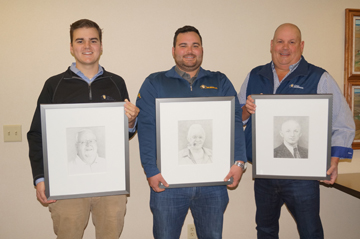
Burrus Seed remains on the cutting edge of seed corn as its operation continues to grow and evolve, meeting the needs for customers now for generations. Tim Greene and his two sons, Griffin and Gannon Greene, will be a part of the fifth generation at Burrus Seed leading the company into a wide-open future of growing possibilities.
