
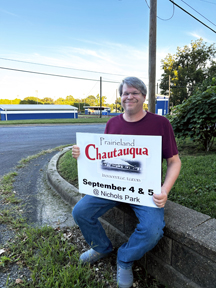
Tradition transitions to year-long series after final 2026 event
By Ben Cox
Photos/Kyla Hurt
For more than a quarter century, Labor Day weekend in Jacksonville has meant the return of an old American tradition to Nichols Park.
Historical figures have come back to life. Musicians have played songs from another time. Scholars, storytellers and reenactors have taken audiences into subjects ranging from Abraham Lincoln and the Civil War to Illinois history and American culture.
This first weekend in September, the Prairieland Chautauqua will take the stage at Nichols Park one last time.
Chad Boehlke, vice president of the Morgan County Historical Society (MCHS) and longtime organizer of the event, says he is stepping away from organizing the traditional stage production after this year. But neither Boehlke nor MCHS is ready to consign Prairieland Chautauqua itself to history.
Instead, beginning in 2027, Chautauqua will move primarily online and become a speaker series spread throughout the year.
“We’re not getting rid of the Chautauqua. Just want to make that clear,” Boehlke said. “We’re just taking it into a different direction.”
It is, in some ways, an appropriate evolution for a movement that has survived for more than 150 years largely because it has changed with its audience.
The original Chautauqua movement began in western New York in 1874 as a summer training program for Sunday school teachers. It quickly developed into something much larger. Chautauqua became a place for intellectual and moral development, combining education, culture and entertainment.
By the end of the 19th century, communities across the country were creating their own Chautauquas, often in open rural settings or near lakes where participants could combine education with recreation and an appreciation for nature.
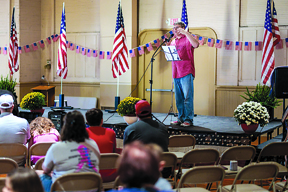
Chad Boehlke addresses the audience during the 2023 Prairieland Chautauqua at Nichols Park in Jacksonville.
The movement emphasized adult education and improvement of the body, mind and soul, reflecting much of the progressive thinking of the period.
Chautauqua became especially popular throughout the Midwest. Approximately 200 independent Chautauquas were operating nationally by 1890. By 1912, that number had grown to around 1,000. Jacksonville became part of the phenomenon that same year.
On Aug. 21, 1912, the city’s first Chautauqua opened at Nichols Park. A large tent went up, a wooden stage was constructed and, for a week, hundreds of people gathered for music, speeches and lectures. Some camped on the grounds while attending the programs.
The national movement eventually faded. Automobiles, radio and changing economics helped erode the
Chautauqua’s place in American life during the 1920s and 1930s. Many disappeared entirely. Old Salem Chautauqua near Petersburg managed to survive until 1942.
Jacksonville revived the tradition in 1999 with the creation of the Prairieland Chautauqua. For the next two decades, the Labor Day weekend event brought an extensive roster of historical interpreters, storytellers and musicians to Jacksonville. After a hiatus surrounding the COVID-19 pandemic, the event eventually returned.
Now, its organizers believe another change is necessary.
“This will be the last stage Chautauqua show that we’re going to do,” Boehlke said. “We’re going to move it to more of an online production, more of a speaker series. So instead of having them all on the same weekend, we’re going to spread them out throughout the year.”
The Morgan County Historical Society board made the decision after watching both attendance habits and the organization’s growing online audience.
Boehlke said the MCHS Facebook presence regularly reaches thousands of people, including many who have an interest in Morgan County history but no longer live in the area.
“That’s kind of the audience that we want to shoot for — the ones that are on Facebook,” he said. “They may not be here in Morgan County, but they have a great interest in our history. And this way they too can be a part of [our] speakers, whoever they might be.”
The format could vary. Some programs could be presented live, others through Zoom and others recorded for later viewing.
It also frees Chautauqua from the limitations of fitting several programs into a single weekend under one theme.
“We could just have maybe one year when we just find whoever we think is interesting,” Boehlke said. “Or one year we might have a lot of local people that want to talk.”
Boehlke particularly hopes the new format encourages Morgan County residents with expertise or an interest in local history to develop programs that the historical society can share with a larger audience.
Music will likely disappear from the new version of Chautauqua. Boehlke said the Jacksonville Public Library’s ‘Concerts Under the Dome’ series already provides a strong outlet for live music, and MCHS does not want to duplicate or compete with that effort.
Before that transition happens, however, there is one more weekend at Nichols Park.
The 2026 Prairieland Chautauqua will be held Friday and Saturday, Sept. 4-5, at the Nichols Park Pavilion. This year’s theme is Route 66 — or, as Boehlke puts it, “Get Your Kicks at the Chautauqua.”
The final traditional program begins at 6 p.m. Friday with Joel Baker presenting “American Giants,” exploring the giant statues, roadside landmarks and other attractions associated with Route 66.
At 7 p.m., Macomb-based folk musician Chris Vallillo will perform. Vallillo, a singer, songwriter and multi-instrumentalist who has appeared in Jacksonville on several previous occasions, brings a background in music and history to the Chautauqua stage.
Saturday’s programs resume at 1 p.m. with a presentation on the history of Route 66.
At 2 p.m., the Lamoine River Ramblers will take the stage. The group performs traditional New Orleans jazz from the early years of jazz history and features contemporary and retired music educators from west-central Illinois and eastern Iowa.
At 3 p.m., historical interpreter Leslie Goddard will explore one of the most enduring parts of the Route 66 experience — food.
Diners, roadside restaurants and other eating establishments became inseparable from the culture surrounding the Mother Road as generations of travelers stopped along the highway.
At 4 p.m., Cindy Boehlke will present “They Left the Light On,” examining the motels and small tourist cabins that accommodated those travelers, including Jacksonville as an example.
Following a dinner break at 5 p.m., the final performer to take the traditional Prairieland Chautauqua stage will be Bucky Halker at 6 p.m.
Halker is particularly suited to close an event built around the marriage of history, education and entertainment.
A Chicago-based singer, songwriter, historian and scholar, Halker specializes in American folk music and has spent
decades researching and performing the music of working people. He holds a doctorate in American history and is the author of “For Democracy, Workers, and God: Labor Song-Poems and
Labor Protest, 1865-1895.” He also served as scholar-producer for the five-volume “Folksongs of Illinois” series and has been closely involved in preserving and interpreting the musical legacy of Woody Guthrie. Halker received an Archie Green Fellowship from the American Folklife Center at the Library of Congress for his work documenting American folk culture.
His appearance therefore brings the traditional Chautauqua full circle. The movement was never intended to provide entertainment alone. Music, storytelling and performance were ways of teaching history and culture to an audience gathered together for the experience.
As it has throughout its modern Jacksonville run, Prairieland Chautauqua remains free and open to the public, with family-oriented programming for all ages.
There is also a certain symmetry in Route 66 becoming the subject of the final traditional Chautauqua.
The highway itself changed the way Americans traveled and helped create a culture increasingly built around mobility. Radio, automobiles and other technologies were among the forces that helped push the original Chautauqua movement into decline nearly a century ago.
Now, another technological shift is taking Jacksonville’s Chautauqua in a new direction, allowing the Historical Society to reach audiences well beyond those who can gather at Nichols Park each Labor Day weekend.
“We’ve been doing stage production since 1999, so it was a very good and long run,” Boehlke said. “But as I said before, times are changing. And people are spending more time online watching things instead of attending things.”
For Boehlke, the important distinction is that the curtain may be coming down on the annual stage show, but it is not coming down on Chautauqua.
After 27 years, the Jacksonville version is simply doing what the original movement sought to do: finding an audience interested in learning something and figuring out the best way to reach them.
“I don’t want to give up our Chautauqua traditions,” Boehlke said. “I just want to keep them going and just take it to the next level.”
