
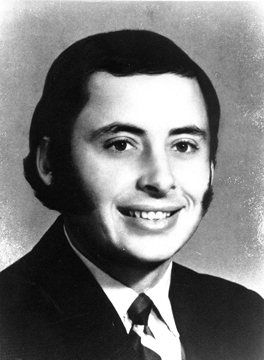
Davidsmeyer bill designates road in memory of local ISP agent killed in 1972
By Ben Cox
The Illinois House of Representatives has adopted a House Joint Resolution sponsored by State Representative C.D. Davidsmeyer (R-Murrayville), which honors an Illinois Bureau of Investigation agent who died in the line of duty on November 27, 1972.
HJR42 designates Old U.S. Route 36 from the I-72 interchange east of Jacksonville to Alexander as the “Special Agent Pete Lackey Memorial Highway.” Lackey was killed on the highway in Morgan County on his way to Springfield to testify in a court case against an alleged well-known drug abuser.
Barron Dean Fonner, 26, of rural Jerseyville, the suspect in the drug case, spotted Lackey driving on U.S. 36 east of Jacksonville on a section of highway known as “Deadman’s Curve” at approximately 7:30 a.m. on November 27, 1972. Bonner rammed Lackey’s vehicle in the rear and attempted to run him off the road. Lackey pulled over to the shoulder of the highway and Fonner jumped through the passenger side window with a large hunting knife in his hand. As Lackey attempted to reach for his service weapon, Fonner slashed his throat and stabbed him 3-4 times in a struggle and left him for dead.
A group of nurses saw the struggle as they drove past the scene and turned around and went back to provide first aid. By the time they returned to Lackey’s vehicle, he had already succumbed to his wounds and Fonner had fled.
The Illinois State Police set up a command post in Jacksonville as police had an incomplete description of the suspect at the time. Fonner was later arrested in Jerseyville at his residence and brought to trial first in Jacksonville in front of Judge John B. Wright. Morgan County Sheriff Harold Wright had been implicated by Fonner’s defense attorney, Robert Owen, of Decatur, in the death of Lackey in August 1973 during pre-trial.
Lackey had allegedly been in a controlled drug buy with Fonner and was set to testify in a case against him, and Wright was implicated in possibly blowing Lackey’s cover in the case and also allegedly involved in local drug trafficking activity that was revealed during testimony.
Owen had Fonner transferred to the Macon County Jail out of fear of adverse treatment at the hands of Morgan County Sheriff’s deputies. The accusations against Sheriff Wright played out in court but had no bearing on the case itself, as Fonner had, on the day of the murder, confessed to his girlfriend at the time.
Fonner was tried in Macon County after a motion for a change of venue after a lot of negative press surrounded the case. Judge Wright eventually barred people discussing the case with the press. The trial was noted for fiery exchanges between Special Prosecutor Thomas Burnham and Owen.
Fonner was later acquitted in the murder of Lackey after his counsel professed self-defense in the case after a month-long trial. Sheriff Wright would later lose
reelection to Henry Jackson in 1974, in part due to some of the negative press surrounding the case. The drug activity accusations never surfaced any illegal activity or formal charges.
More than 15 years later, Fonner mailed a death threat to Philip Kocis, Commander of the Illinois State Police, who worked with Lackey in 1972 on several undercover narcotics investigations. Kocis was even called as a witness at Fonner’s trial in Decatur. Fonner also threatened to kill Chief Judge Harold Baker of the Central District of Illinois, who sentenced Fonner in 1982 for threatening President Ronald Reagan. Fonner then admitted to killing Lackey under the influence of narcotics while sentenced to a psychiatric facility in an interview with the State Journal Register. Fonner later died in prison in 1992.
Lackey had served for two years with the Illinois Bureau of Investigations (IBI, a predecessor to the Illinois State Police) and was survived by his wife and two children. Prior to serving with the IBI, he had been a physical education teacher and coach at Winchester High School. Lackey was the first IBI officer to be murdered while on duty.
Lackey was one of two Illinois State Police officers to die in the line of duty in 1972. The resolution was adopted unanimously by the Illinois House 114-0.
