
By Chad Boehlke
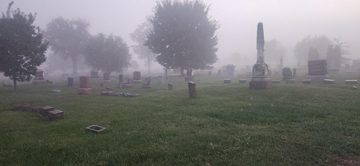
Stepping onto the grounds of Jacksonville East Cemetery, established in 1833, is like stepping into the rich history and mysteries of Jacksonville. It’s a place that holds the stories of our past and the memories of our ancestors.
Jacksonville East Cemetery, as we know it today, was originally Jacksonville Cemetery. After 1866, with the establishment of Diamond Grove Cemetery, it is possible that this original name was expanded to include “East.”
The 30-acre-plus property is located on the northeast side of Jacksonville, at the corner of Myrtle and Lafayette, with Mauvaisterre Creek to the east. This cemetery contains over 13,000 known burials, including many well-known and also unknown citizens of Jacksonville, from the early 1830s to the present.
City acquires property
The original property, which was nine acres, was sold to the City of Jacksonville on May 20, 1833. Before the sale, the land was owned by Abraham B. and Mary Ann Dewitt. It was George Hacket, Aylett H. Buckner, James Parkinson, Ira Davenport and Calb Beach who represented Jacksonville and paid $200 for the land to be held and kept as a public burial ground. The 1833 original sale did not list any burials before 1833.
After the 1830s, a new rural cemetery movement aimed at making cemeteries more “park-like” was gaining momentum, spreading from the East Coast through to the Midwest. At some point after 1833, the original or old part of what the cemetery staff calls “the hillside,” which includes the location of John Hardin’s large stone memorial, was landscaped with “burial mounds” and narrow roads in between them.
Diamond Grove Cemetery represents this concept of a park feel more than Jacksonville East Cemetery. East only had “burial mounds” and, at one time, many trees. After these burial mounds were full, the narrow roads were used as burial lots because they were viewed as a waste of land, which is why there are early graves alongside later ones. Some “streets” run through the original cemetery; however, they are now overgrown with grass and challenging to identify.
The maps of the original cemetery mention that “The old county burial ground was in this area, between the Jacksonville East Cemetery and Mauvaisterre Creek, a few yards East of here.”
These “early burials” would be between row A and the creek heading east; however, after much research, this can’t be verified. A walk in this area did not yield any signs of old graves; only old bricks, concrete, and 1900s-era bottles and dinnerware were found.
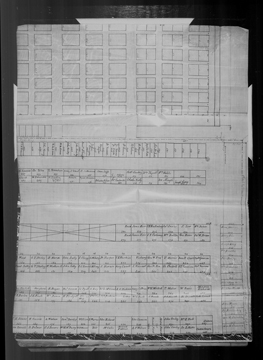
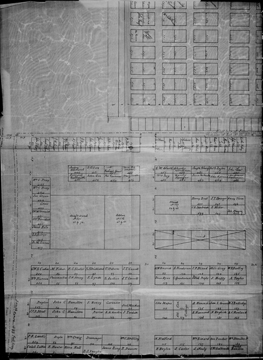
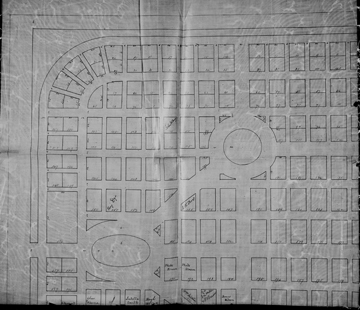
The oldest known maps of the burials are found in the Morgan County Courthouse land records book ZZ. These maps date to 1867 and list the location of the people and families buried in the lots. However, these same maps show two extra circle drives, located in the new part, which never became a part of East. So, what happened to them? Research did not uncover any earlier maps; thus, it remains a 192-year-old mystery.
The first burial
The first recorded burial in Jacksonville East Cemetery was thought to be John Barber, who succumbed to cholera on June 29, 1833. His burial, listed as August 15, 1833, marks the first recorded death in Morgan County, according to the Morgan County Historical Society.
Cholera is believed to have come to the area around June, and by the end of August of the same year, about 50-60 Morgan County residents died from the disease. One of the earliest known graves in East is that of Joshua Howell Gest, who died from cholera on July 15, 1833.
By the end of the year, about five members of his family would also die and be buried in the same location, lot 30. Ownership records of the Gest lot listed Newman York. Could this be an error? A records search does not clear why York is listed as the owner in 1867.
As far as records go, nothing was mentioned about the cemetery having a receiving vault, which is a designated area where bodies are temporarily stored until a grave can be dug. Perhaps the burials happened within a few days of death, because embalming was not standard until after the 1860s.
Some of the early grave markers were most likely made from wood. The earliest headstones in east are Gothic style brownstone or sandstone from the 1830s to 1860s. It wasn’t until the 1850s that railroads brought in marble and limestone to be used as headstones, and later granite.
East Cemetery surprisingly does not have any zinc, also called “White Bronze” premade “tombstones” that are ordered from a catalog; however, Diamond Grove has a few.
Group plots
Besides family and single plots, East Cemetery has a few special plots for organizations and groups. Plot 536, the location of the Civil War cannon, was established in the early 1900s as Soldiers Field.
This plot, originally designated as parking for carriages, wagons, and saddle horses, became the resting place for soldiers of the Civil War. It would soon fill with about 129 graves of veterans from the Civil War, World War I, World War II and other conflicts.
The first veteran burials in this plot were Abner Upham, Edward Anderson and John E. Gary, all killed at the Battle of Sugar Creek, Arkansas, in 1862. The local Grand Army of the Republic Matt Star Post, formed in 1884, oversaw many burials, possibly leading to the plot’s referenced name, Soldiers Field.
The next group is the Independent Order of Odd Fellows. The local IOOF in Jacksonville was first formed in 1837, making it one of the oldest Odd Fellow lodges in the nation. It remains strong to this day. Their plot is 535, just south of the Soldiers Field plot. They have about 73 burials. This plot was initially designated for the “Deaf and Dumb,” first listed on the 1867 map. Just across the street to the north of Soldiers Field is plot 537, designated for the “School for the Blind,” now known as Illinois School for the Visually Impaired, with approximately 32 burials, including 18 students from the school.
Another known plot set aside was the “Public Burying Grounds” for individuals who could not afford a plot. According to records, the area, labeled on the cemetery map as “unplotted area used for Public Burying Grounds,” located between Central Avenue and North Drive, contains the remains of approximately 654 people.
Few people in this plot are listed as unknown, and some of the earliest dates found are from 1888. However, before this established plot was created, there were no records indicating where these people were buried before the designated area.
In 1867, Illinois College had two plots, 119 and 120. The reason behind this is unknown.
East Cemetery has a “baby land” area set aside for deceased babies — this area, located in section E, row 2, lists 48 burials. However, about 188 babies are buried throughout the cemetery.
Improvements to the cemetery
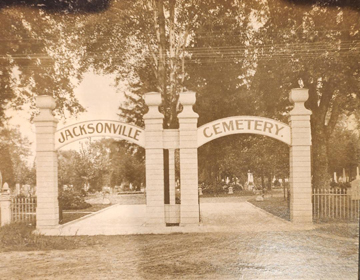
After the establishment of Diamond Grove Cemetery in 1866, improvements were made to Jacksonville East Cemetery. First, the City of Jacksonville declared that “The old cemetery shall be forever kept, cared for, preserved, and adorned” on May 14, 1866.
This means that the city will take over the landscaping; previously, it was the families’ responsibility to care for the graves. In July of the same year, the town erected a picket fence around the original East Cemetery. On one of the 1867 maps, a “Proposed line of East Fence” is listed between lot A and the creek.
The metal fence along Myrtle Street today was once installed in the town square in the 1900s. Also in the same month, the town proposed building two sexton houses at both cemeteries. Diamond Grove was the only one that had a house built on the east side along Lincoln Avenue.
The proposed house for East was defeated. Many families also moved their burials from East to Diamond. For example, Governor Richard Yates once purchased lots 35 and 36 in Jacksonville East Cemetery before ultimate burial in Diamond Grove. Others like Elihu Wolcott, who had lot 22 in East, are now at Diamond Grove.
Plot costs and significant events
The cost of burial plot sales is recorded in the land deeds at the Morgan County Courthouse. For example, N. M. Williams purchased his plot in 1851 for $2.50, while James Redman bought his in 1868 for $10 and James Eads bought his for $5. Perhaps the different prices indicated the size or the number of graves in each plot. A cemetery report, published in the local newspaper in 1899, listed J. F. Nagle, the sexton at the time, costing $4 per dug grave. In 1901, it was 17 cents per square foot to open a grave.
Two significant events took place at Jacksonville East Cemetery. First, the most abrupt change that the East experienced occurred on June 5, 1957. In a matter of 30 minutes or so, a storm arrived with heavy rain and strong winds, which blew trees over, uprooted coffins and knocked over headstones. The next day, volunteers came with equipment to clean up the torn landscape. The second event occurred when the new brick office, built in 1976, exploded just before its dedication on Memorial Day due to a gasoline leak.
Presently, one can find out who is buried in Jacksonville East Cemetery through several online sources. But it was Robert W. Dalton, who in the mid-1970s and 80s, traveled Morgan County, looking for and recording all the cemeteries within the county lines, including those in East.
This research was typed and printed for all to use. The Jacksonville Area Genealogical & Historical Society, now located on the second floor of the Jacksonville Public Library, is where most of the information for this article originated.
Today, the cemetery, nearly 200 years old, remains in use and contains the remains of many local African Americans, veterans from all U.S. wars including the Revolutionary War, and individuals who helped build Jacksonville. Our local cemeteries are full of the history of those who called Jacksonville home.
