
One of Jacksonville’s first Black landowner families takes root in the 1800s
By Chad Boehlke
By the late 1830s, Jacksonville was well on its way from a Western hamlet on the edge of a prairie to becoming a vibrant political, educational and economic center that attracted individuals and families seeking economic opportunities.
These families, primarily from New England and the Southern states, viewed Jacksonville as a promising opportunity. However, a small population that often gets overlooked is the free African Americans who also came to Jacksonville seeking the same economic opportunities.
By the 1850s, this small Black population had reached about 100 people and had settled in a small neighborhood southwest of the square named “Africa.” Single men, women and families bought properties, built homes and churches, and even established a school. This neighborhood is primarily located in the Duncan and Clark Addition, encompassing modern-day Marion, Rockwell, Anna and South Church streets. This area became the heart of the historic Black neighborhood for over a century. The Duncan and Clark Addition was established in 1833 by Joseph Duncan and his brother-in-law, Mathew St. Clair Clark.
One of the first Black purchasers in this addition was Andrew Jackson, a freedman, pastor and local leader, who bought many lots from Duncan. In return, Jackson sold many of those lots to freed Blacks who came to Jacksonville. Being “free” in Antebellum Illinois for African Americans was not really freedom. Many states, including Illinois, had Black Codes or laws that severely restricted the freedoms of African Americans who chose to live in Illinois.
For example, in 1829, Illinois passed an anti-immigration statute to prevent free Blacks from moving to the state to settle. This law required non-property owners, who were also free Blacks, to pay a $1,000 bond before settling in the state. However, the law left a loophole: no bond was required if the freed person owned property.
Despite the formidable Black Laws, designed to dissuade freed Blacks from land ownership, Sophia Woodfork emerged as one of the earliest female Black residents to purchase a lot in Jacksonville.
A freedwoman who arrived in Jacksonville about 1839 with her daughter, Louisa, as a single mother and free Black woman, she defied the odds by purchasing her land. This feat was rare for women, especially African Americans, who typically required a male to buy land on their behalf. This unique aspect of their story underscores the remarkable resilience and determination of the Woodfork-Givens family.
Despite the challenges, Sophia was determined to provide a better life for Louisa. Sophia was born into slavery around 1805 in Virginia. At 20, Sophia lived in Tennessee and had her only child, Louisa.
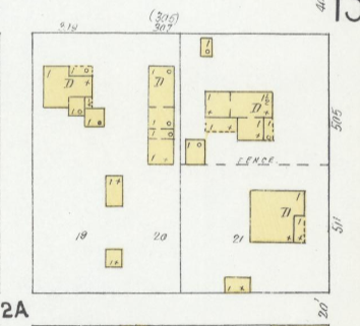
At this time, Sophia was using the last name of Woodfork for Louisa. Records don’t talk about where Sophia obtained the name of Woodfork. Sophia’s life remains unknown for the next fourteen years until she appears on the local land deeds in Jacksonville, where she purchased a city lot from Andrew Jackson in 1839. She paid $130, or roughly $4,400 in today’s prices. By 1854, a tiny house had been built on lot 20.
By 1845, Sophia had become a grandmother when her daughter, Louisa Woodfork, gave birth to a daughter, Frances; the father’s identity is unknown. Four years later, in 1849, Louisa, age 24, married John Harmon Givens, 34, a laborer in Jacksonville who owned several properties near Sophia, and the 1850 census indicated that the couple took in boarders.
By 1852, Givens sold three lots that were his for $150. It was also at this time that Louisa’s mother, Sophia, bought lot 19 from Andrew Jackson for $140. Jackson was one of the first black purchasers of the Duncan and Clark Addition, and he played a significant role in helping other freed Blacks, including the Woodfork/Givens family, to settle in Jacksonville.
Louisa and Givens’ union bore three children: Josephine, born in 1852; Andrew, born in 1854; and Christopher, born in 1858. Their growing family was a testament to their resilience and determination to live in Jacksonville despite the Black laws that severely restricted their freedom. Their unity and strength as a family unit, palpable in their shared journey, are a source of inspiration for all who value the power of family.
By 1860, the local census detailed the family’s living situation. Givens, now 44, and Louisa, 35, were living in one house with Louisa’s mother, Sophia Woodford, 60, and their children: Frances Givens, 15; Josephine Givens, 8; Andrew Givens, 6; and Christopher, 2.
Since Sophia lived with her daughter’s family, her house, lot 19, might have been rented out. The Givens family changed by 1864. Givens and Louisa divorced, and by 1864, Givens married Anna Burton. By 1868, Givens lived on East Street while Louisa lived on Grove Street. According to local records, but the 1900 census, Givens was still married to Anna and residing at 434 Ebey St.
However, the 1870s brought significant changes to Louisa’s living situation. The 1870 census listed Louisa, now 45, working as a washerwoman, along with her mother, 65; son Christopher, 11; daughter Josephine, 19; and 14 other people living with her. Her real estate value was $2000, equivalent to $48,000 today. In 1875, Louisa purchased lot 19, her mother’s home, while she was living on Grove Street.
Sophia Woodfork must have died shortly after 1880, for she was not listed in the 1880 Morgan County Census. The census listed Louisa, 56, as a widow and keeping house on Marion Street until 1885, when she sold both lots, 19 and 20, to William H. H King.
She was living at 402 Marion Street as late as 1887 with her adult child, Josephine, 28, who lived with her and made and sold hats. 1887 was the last year Lousia was found in records. The burial location of Sophia and Louisa is unknown. Local cemetery records show only her son, Christopher Givens, as buried in East Cemetery.
The Woodfork/Givens family, a small handful of freed African Americans who owned land in Jacksonville before the start of the Civil War, achieved a remarkable feat. Their story is a testament to the resilience and determination of African Americans in the face of adversity.
Through the nineteenth century, Jacksonville, Quincy, Alton and Springfield had some of the highest concentrations of African American residents in Central Illinois. Today the homes of Sophia and Louisa on Marion Street are long gone, removed in the 1960s by the local housing authority.
The 1905 Sanborn Fire Insurance Map showed the location and size of their homes. The Woodfork/Givens family’s achievements are a source of pride for their descendants and the African American community, instilling a sense of pride in all who hear their story.
