
By Dr. Justin Hamel, DC, MS
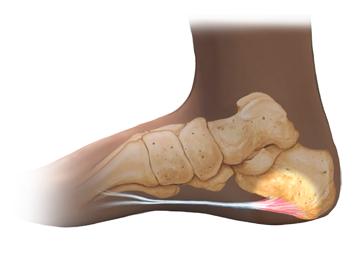
It’s 5:30 Monday morning and you are awakened to the familiar sound of your alarm. You sit up, gently stretch and put your feet on the floor. At that moment, you are suddenly hit with a sharp, stabbing pain located near your heel. The next several steps are just as painful as you limp to the bathroom. Over the next few weeks, the pain intensifies and becomes less of an inconvenient nuisance and more of a full blown problem. You begin to think how far you will have to walk for different tasks. Will it flare up more? Will more movement heal it? With a trip to your physician or maybe some online research, you learn the root of your aching feet is plantar fasciitis. The pain is caused by the inflammation of a thick band of tissue that runs across the bottom of each foot. The tissue connects the heel to the toes. The condition is not uncommon, as it is estimated to affect 2-6% of the population each year, and 10% of people will experience a flare-up in their lifetime.
The common causes are increased activity (such as running or jumping), improper footwear (lack of arch support), biomechanical issues such as flat feet or high arches, obesity and medical conditions such as rheumatoid arthritis, lupus or traumatic injury.
The good news is that if you catch this condition early, you can usually treat it with conservative care at home. A simple treatment plan is outlined below.
Phase 1: Reduce pain and inflammation
- Start wearing more supportive footwear and discard shoes that might be leading to the symptoms.
- Ice and gentle message: Roll the bottom of your foot gently with a frozen water, tennis ball or any number of plantar facilities recovery tools that can be found online.
- If possible, decrease strain on your foot by limiting running, jumping and standing on hard surfaces for an extended period of time.
- If the symptoms are starting to decrease, start using stretches for the Achilles tendon, calf and plantar fascia. There are numerous safe stretches that can be found online.
If the symptoms are still present after a few weeks, move to phase 2.
Phase 2: Seek the help of a physical medicine specialist (chiropractor or physical therapist)
A physical medicine specialist would likely treat it with a variety of therapies. An example and the treatment utilized in our clinic is as follows.
- For immediate relief of trauma induced injury, I would use a high-pressure, localized cryotherapy device to reduce pain and inflammation in seconds.
- Next, I would utilize a Class IV medical laser. These treatments are gentle and soothing, and have the ability to reduce inflammation and improve healing on a cellular level.
- Instrument-based soft tissue therapy (IASTM) and flossing will break up adhesions, promote blood flow and break down fibrotic tissue.
- Kinesiology tape is used to reduce swelling, support tissue and reduce pain.
- Functional rehabilitation is done with all associated joints and soft tissue.
- Recommend over the counter or custom orthotics if needed.
- If symptoms are not significantly improving within 2 to 4 weeks, refer out to a podiatrist for imaging and possible medical intervention.
While plantar fasciitis can be debilitating, one does not have to endure the pain long-term. Multiple effective non-invasive options for treatment exist, and following the steps outlined above can have you back on your feet!
Dr. Justin Hamel and Clara Hamel have a combined over 30 years of experience in health fields. Reach them at 1° Performance & Longevity, located at 46 N. Central Park Plz., Suite 101, in Jacksonville, on Facebook or by phone at 217-243-6358.
Dealing with plantar fasciitis
By Dr. Justin Hamel, DC, MS
The Source Newspaper
It’s 5:30 Monday morning and you are awakened to the familiar sound of your alarm. You sit up, gently stretch and put your feet on the floor. At that moment, you are suddenly hit with a sharp, stabbing pain located near your heel. The next several steps are just as painful as you limp to the bathroom. Over the next few weeks, the pain intensifies and becomes less of an inconvenient nuisance and more of a full blown problem. You begin to think how far you will have to walk for different tasks. Will it flare up more? Will more movement heal it? With a trip to your physician or maybe some online research, you learn the root of your aching feet is plantar fasciitis. The pain is caused by the inflammation of a thick band of tissue that runs across the bottom of each foot. The tissue connects the heel to the toes. The condition is not uncommon, as it is estimated to affect 2-6% of the population each year, and 10% of people will experience a flare-up in their lifetime.
The common causes are increased activity (such as running or jumping), improper footwear (lack of arch support), biomechanical issues such as flat feet or high arches, obesity and medical conditions such as rheumatoid arthritis, lupus or traumatic injury.
The good news is that if you catch this condition early, you can usually treat it with conservative care at home. A simple treatment plan is outlined below.
Phase 1: Reduce pain and inflammation
- Start wearing more supportive footwear and discard shoes that might be leading to the symptoms.
- Ice and gentle message: Roll the bottom of your foot gently with a frozen water, tennis ball or any number of plantar facilities recovery tools that can be found online.
- If possible, decrease strain on your foot by limiting running, jumping and standing on hard surfaces for an extended period of time.
- If the symptoms are starting to decrease, start using stretches for the Achilles tendon, calf and plantar fascia. There are numerous safe stretches that can be found online.
If the symptoms are still present after a few weeks, move to phase 2.
Phase 2: Seek the help of a physical medicine specialist (chiropractor or physical therapist)
A physical medicine specialist would likely treat it with a variety of therapies. An example and the treatment utilized in our clinic is as follows.
- For immediate relief of trauma induced injury, I would use a high-pressure, localized cryotherapy device to reduce pain and inflammation in seconds.
- Next, I would utilize a Class IV medical laser. These treatments are gentle and soothing, and have the ability to reduce inflammation and improve healing on a cellular level.
- Instrument-based soft tissue therapy (IASTM) and flossing will break up adhesions, promote blood flow and break down fibrotic tissue.
- Kinesiology tape is used to reduce swelling, support tissue and reduce pain.
- Functional rehabilitation is done with all associated joints and soft tissue.
- Recommend over the counter or custom orthotics if needed.
- If symptoms are not significantly improving within 2 to 4 weeks, refer out to a podiatrist for imaging and possible medical intervention.
While plantar fasciitis can be debilitating, one does not have to endure the pain long-term. Multiple effective non-invasive options for treatment exist, and following the steps outlined above can have you back on your feet!
Dr. Justin Hamel and Clara Hamel have a combined over 30 years of experience in health fields. Reach them at 1° Performance & Longevity, located at 46 N. Central Park Plz., Suite 101, in Jacksonville, on Facebook or by phone at 217-243-6358.
