
By Ben Cox
For almost 50 years, the easygoing and plain spoken nature of Todd Burrus has quietly defined him as one of West Central Illinois’ top agriculture leaders.
Like all of the Burrus children before him, he got his start in the fields, detasseling corn in Arenzville alongside many others. The time-worn summer chore of detasseling corn has seen Burrus employ over 10,000 people over the years. The work is laborious and sometimes hot, but the relationships built have lasted a lifetime.
Todd Burrus worked the fields and was head of detasseling for a number of years. Generations of workers have sent correspondence back to the Arenzville office thanking Burrus Seed for the opportunity to work. For many, it is their first work experience.
Todd Burrus’ milieu is still on the physical side, working in the production portion of the Arenzville facility supervising the agronomy team of four full-time employees. His easygoing nature and quiet demeanor seemed best that way, or at least that is what his father, Martin Burrus, believed.
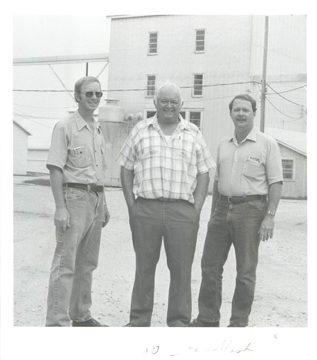
Education was also a part of the Burrus family. Todd Burrus was involved in the 4-H program in school and found himself at the University of Illinois Champaign-Urbana in the fall of 1972. His matriculation to Champaign couldn’t have come at a better time. The ag program at U of I was shaped by the boom and bust of the nation’s ag sector.
The university’s College of Agricultural Engineering and College of Agriculture contributed to the industry’s evolution through research, new facilities and the creation of the university’s Department of Agricultural and Consumer Economics. The decade also saw the Plant Variety Protection Act of 1970, new agricultural research facilities at the university and the formation of new intercollegiate judging teams, and the first agricultural progress show in the state.
Burrus found himself in the middle of all the change at the university on the school’s livestock judging team and as a part of the Pi Chapter of Alpha Gamma Rho. Burrus graduated with honors with a general Bachelor of Science in Agriculture and found himself faced with a choice upon his return to Arenzville in May 1976.
Fast-forward to 2025. Burrus Seed is celebrating their 90th anniversary and this author’s pilgrimage to the Burrus Seed office leads to its discovery, tucked against the rolling bluffs of the Illinois River valley and with Indian and Prairie creeks cutting their flows through the hillside.
The BNSF railroad bridge cuts over Indian Creek just south of town. The Burrus ground sits up on a hill near the Arenzville blacktop road and it is flat corn for miles, like it’s straight out of a painting. The offices sit in the middle of the facility’s grounds. The office is like any other, with desks and the buzzing of phone calls and people typing at computers. Black-and-white and faded technicolor pictures of the last 90 years dress the walls.
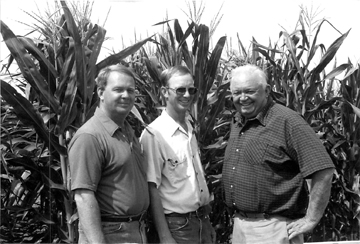
Tim Greene, current president of Burrus, leads me back to a conference room and gives me a nice cup of black coffee. On the north side of the conference room is a large picture window with the million dollar view over the farm ground. Greene explains to me the offices sit on top of where the original building on the property was built. Todd Burrus strolls in with a smile, provides a firm handshake and a joke or two. Then, the memories start to wash through the room for the next 35 minutes.
Ben Cox: So, tell me where you started.
Todd Burrus: At the bottom pretty much, didn’t we? [He turns toward Greene and laughs.] Yeah. Actually every family member took some time to learn to detassel corn. I don’t know if you ever got to detassel, but that was my first job. My brother was my supervisor and I thought I was a pretty good detasseler, but some of his comments wouldn’t have necessarily said he saw it the same way I did, but that would’ve been when I was 13.
BC: It’s a good place to start because it’s physical work, but you get to meet people along the way. How many cents were you paid per bushel?
TB: (laughs) Oh, I don’t have enough memory for that one. I wouldn’t have a clue.
BC: My good friend Tom Irwin from near Pleasant Plains wrote a song about that kind of job called “Shucking Corn.” I think coming from an area like this, you have to try it at least once.
TB: Oh yeah. It was 1976 when I came home from college. Well, one thing that I thought was significant, my dad sat down with me and said, “First of all, we’d be glad to have you come home and go to work with us, but if that isn’t what you want to do, I’ll love you as a son, but you don’t have to work here. So you need to make a decision whether this is what you want to do or not what you want to do.”
And he fleshed it out. He said, “If I decide for you when the tough days come — and they will come … when the tough days come, you’ll be looking to leave. If you decide this is what you want to do when the tough days come, you’ll be working on how do we have less tough days, but you won’t be thinking about going somewhere else. One of those we need and one of those we don’t need.”
Dad was a very plainspoken guy, but I loved how he explained it, and we have passed that on to the generations following us. It just makes sense. I kind of worked as Tom’s assistant for a couple of years. Tom was five years older than my brother, five years older than me. And then there came a time when Dad sat us down and said, “I’ve looked at it, and really Tom, you’re going to be a better fit — your personality’s better fit for sales and you ought to move into the sales side of our business. And Todd, you’ll do fine on the production side of our business and you won’t have to be under Tom the rest of your life. You’ll have your own area and you’ll take ownership of it.” And so that worked extremely well.
Tom was a great partner. He was a great friend, he was a great brother. We had the same goals and we operated in different realms. We’d crossed paths some of the time enough to appreciate what each other was doing. It was just a high level of trust. That’s always good to have. Oh, it makes all the difference in the world.
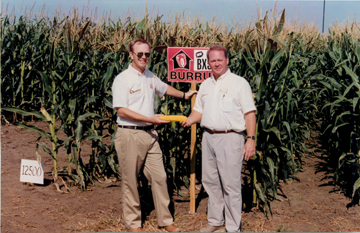
I ran the farm then for a little over 30 years. I enjoyed being here local, enjoyed the crew, enjoyed the staff and the local relationships. Tom at the same time, he was working on sales and our sales grew and our footprint grew. My son, Kevin, came home from college and we had worked at having him to touch a lot of experiences while he was in high school and college throughout the business. When he came home, he worked under me for a couple of years, but we rapidly transitioned the leadership of the farm to Kevin and it’s been amazing to watch him grow into that man. He’s doing things that I never would’ve dreamed of, you know what I mean? It’s fascinating to watch that. I moved over to where I gave a little more support to the sales team, to the overall management team. Today, I provide leadership for the agronomy staff. It’s a group of four full-time employees and I provide leadership there. I think one of my natural gifts is to be an encourager. Honestly, when COVID came along, I had a full-time job.
BC: I believe it. Those were bumpy days for all of society. I remember them too well. I had been in my position at the radio station in Jacksonville for three years at that point, and it was the biggest thing that had come along that affected everybody. Speaking of affecting everyone, I imagine the last 30 years in this business, you can probably tell me that it has changed quite a bit.
TB: It is amazing to look back actually in the field. We can look back 90 years ago to be really honest, and it’s unbelievable from a product standpoint, but it’s also just how businesses changed, agribusinesses changed. It’s not a bad thing by any means. It is pretty invigorating to think about the changes and then also think about are there some principles that have just as much value as they did 90 years ago or 50 years ago in terms of ethics and honesty and authenticity as they do today. There’s some things that just have value every day, those kind of foundational things. We don’t want to see those go away. It’s okay for some things to change, but then it’s okay for some things not to change.
BC: How has the company been able to stand out all this time?
TB: I think one of the things that sets us apart is a very basic premise. National companies can throw a lot of money at advertising that we just don’t have the wherewithal to do, but they need to select a minimum of products that will go across the whole U.S. We need to select products that are going to work in our footprint, and quite frankly, it’s easier to find a product that will do well here, not do well here and everywhere else.
That is one of our competitive advantages is that our tight footprint allows us to have a very effective product portfolio and to actually bring an advantage in our footprint.
BC: That leads me to my next question. Nationally, the Bloomington-Normal area, McLean County, is one of the top corn producers in the nation. One of the top soybean producing areas isn’t too far away. I believe it’s in eastern Iowa. How much has Burrus played a hand in creating that environment for literally being the bread basket of the nation?
TB: I’ve got a chart that’ll show that, but the U.S. corn yield was 25 bushels an acre for a long time up until 1935. When hybrid seed corn began at that point, the graph changed in terms of what the U.S corn yield looks like, and it’s gone from 25 bushels an acre, and 35, to 187 today on a very steady incline. We’ve got to be a part of that and we’ve got to adjust to that. I mean, our products have stood the test of time. Our processes, our people have stood the test of time and kept up with the changes. I think that’s a tribute just organizationally to our whole staff.
BC: I have a relatively short memory as far as farming, and I know there were some rough patches in the 1980s and early 2000s. Even right now, there’s some questions and instability in farming. How have you all managed to ebb and flow with the ups and downs of agriculture in this country as well as you have? I mean, can you point to any one thing that has helped you other than concentrating here locally?
TB: I think one of the keys is to focus on how do we bring value to that customer and how do we continue to keep a long-term view when there’s a cyclical nature going on around us where agriculture’s going to have good days, it’s going to have tougher days, but how do we bring investments in seed that will bring a return on that grower’s dollar?
You can have a long debate whether investing in seed is the best when the economy is really good for the farmer, or whether it’s the most important investment when it’s really tough for the farmer. It looks to me like a long-term process that says, how do I bring value? How do I do things with the seed that when a grower invests dollars with us, he’s going to get more return out of that investment than some of the alternatives that are available when times are good.
We don’t try to gouge people when times are tough. We try to be in a position where we’re a sustainable business for our customers and for them to know they are going to have ongoing success with our products.
BC: The underlying theme I think I heard going back to the work with your brother and just from the sales side is a very key word in all of it is trust. I drive the highways and I see Burrus Seed signs. How does that make you feel being a part of this company for most of your life to know people trust you, trust your research, trust that you’re going to give them an individualized plan for their return on investment? How do you build it and how do you maintain that trust? I mean, it sounds like it’s making the right connection with people.
TB: It is. Listening to that grower really close is one of the keys. The ability to understand our responsibility in that relationship, to thoroughly investigate, to bring forth things that will help that grower and not bring forth things that will spend his money but not get him a return on an investment – we have both of those responsibilities within that relationship.
I think if my son, Kevin, was here, the term I’ve heard him use several times is stewardship. We’re a steward of that customer relationship. We’re a steward of our company, our family business while we’re here and we’re going to do the best with that while we’re the steward of that. Then, in the meantime, we’re hoping to be developing the next generation to where they have those same values and those same visions. The customer is going to continue to need help. The seed world is not simple, it’s complex. It’s gotten more complex over time. When I look ahead, I think it will continue to get more complex and they need to look to somebody that they trust that can help them make the final decisions on their own. And it should be. They’re the ones who have the authority, but at the end of the day, that responsibility to help them, they’re going to look for somebody that they trust to help them make good choices. And that’s our rule is to help them make a good choice.
BC: Coming from Greene County, I just think of the generations of families that have always worked together. It seems like that echoes here a little bit — generations of families and neighbors working together to get the best out of their crop because a rising tide raises all ships. Last question, and if you can answer it, go ahead. Where do you see the next 90 years going? And I know that’s a big loaded question because that requires a little bit of foresight, but I’m interested to hear it with all the knowledge that you have in this business.
TB: It is pretty interesting to me. I’ve thought several times here with this 90 year celebration, I’ve thought, oh my gosh, not in Grandpa’s wildest dreams would he imagine where we are today. There’s just no way. I went back just recently in history and in the mid-1930s, they’re just transitioning from steel wheel tractors to rubber tire tractors. It is easy to think short term, but I think there will be a lot of changes in some of the very things we’ve talked about.
I see genetic gain continuing. There was a debate not that many years ago, well, are we at the end of genetic gain? I don’t think so. I think the tools we’re discovering today open that up to greater avenues. I think that we’ll figure out ways to do more with less people and do more with more equipment, more technology, more computer aid. My suspicion says that it’s beyond my vision of what that [future] could look like.
Just to be very, very honest with you. I think the speed of change goes beyond my ability to think that far down the road. On the other hand, I look back and I think what’s going to be necessary and important, what do we need to be doing now to prepare for the changes that are coming that are beyond the horizon, beyond our ability to see? I see that the same needs for honesty, for people relationships, for understanding what’s going on and why it’s going on. I mean, there’s things that’s happened in the last couple of months that social media brings, oh my gosh, almost an overreaction and a lot of noise. That’s not crystal clear. If we can communicate effectively and help people sort their way through lots of information to get to good information, there’s going to be a place for this business.
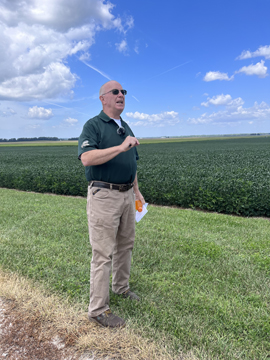
At the conclusion of the interview, Todd Burrus, Tim Greene and communications manager Olivia Sellers led me out to their scientific plot on the west side of the property. The plot holds every hybrid that Burrus has ever distributed. The stark differences from 90 years ago to today is fascinating. The old-fashioned handshake, the smile, the honesty and the candor — well, those things haven’t changed in 90 years. Todd Burrus has been at the foundation of all of that, laying the groundwork for his family to continue those traditions well into the future.
