
Inspired by her son, Deb Martin reaches out to spread awareness and help to prevent suicide
By Marcel Pacatte
Waverly’s Deb Martin is soft-spoken with an easy laugh but she wants you to know some things — and when she does, you sense not so much an edge but a purpose.
None of this started by her choice. Had it been up to her, her son, Jared Martin, would be approaching his 30th birthday, not 12 years gone, a suicide at 17. The group — the foundation — that grew out of his death, Jared’s Keepers, never would have happened.
Even though this wasn’t her choice, all of it after his death, it had to happen. It needed to happen.
Because?
“I didn’t want any other family to go through this,” she shares.
Because?
“If this can happen to Jared, it can happen to anybody,” she shares.
It’s why still, right now, day or night, “If someone needs to talk to me, I’m there,” she affirms.
And she said, smiling but not laughing, the crises always seem to happen at night. That’s OK, though. As long as they have somewhere to turn, someone who will pick up.
The foundation wasn’t her idea, not even its name. All of it was organic. All of it came to her, presented itself. First, in the days and weeks after his suicide, came the calls and messages to her from his high school friends in Tennessee, where he had gone to school before moving with her to the Virgin Islands.
“Miss Debbie,” Martin recounts, “they’re not listening to us.”
His friends were reaching out for help at school. They were hurting. Some, like him, were suicidal. And no one at the school seemed to be listening. Or caring. Certainly not enough.

She told them that if the teachers weren’t listening, to go to the counselors. And then when the counselors weren’t listening, to go to the administrators. And then on to the school board. They shortly found themselves at the capitol in Nashville, visiting every single legislator in one day and even the governor.
“That’s what I love about these kids,” Martin says. “They didn’t know.” Protocol. Courtesy. Legislative process. They just knew they had had enough of slammed doors and unresponsiveness. Someone was going to listen. Someone had to listen.
The difference at the capitol was that television cameras and reporters were along. One legislator invited the kids back to his office later that day. He listened.
He asked them what they wanted
The eventual result of that day was a bill introduced by that senator, Kerry Roberts, to address the need for care. Every employee of every school district in the state would be trained in all aspects of suicide prevention. It passed unanimously. Those kids. Those cameras.
This was mere weeks after her son’s death. Forty-five days from funeral to foundation. Everything still was raw, but these kids needed her, and there still was time for her to do something to help them.
Soon she was in schools, speaking at assemblies, telling the story.
How?
You just do. At first, she didn’t have a plan. She said she just knew she needed to do something.
She said there was a lot she didn’t know, both about how this would work, and things about her son. She said she found out he had a network in the soccer world, because she heard from soccer teams, coaches and players — people who had been talking to her son about playing for them. About the future. They reached out to her as the news reverberated … So sorry. Is there anything we can do?
That’s not something you want to say to Deb Martin unless you mean it, because you will be given a to-do list, thank you very much.
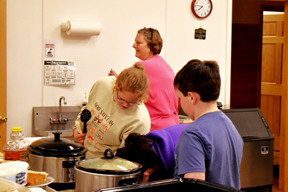
Deb Martin, center, is president of Jared’s Keepers Foundation, an organization that works to prevent suicide among youth. One of the components of the foundation’s work is Feeding Our Families, a free program for junior high and high school students. In the foreground are Bella Prusak, left, Kimmie Hurley (bent forward) and Aaron Harris, all who have participated in the program.
Another thing she didn’t know, she said, was the extent of the problem.
She said she soon realized that the numbers at her son’s former school told a stark story: Kids were taking their lives, or trying, or groping for help.
Some stats: In her son’s school alone, students had lost nine parents to suicide. Jared Martin’s father, Daniel, was one. It tore the family apart. Suicides often, but not always, follow patterns within families, whether silently or openly.
Six students at his school in six years had committed suicide. And 29 students in his class of 210 had attempted to kill themselves.
She said that despite all of this, no infrastructure existed to help the students. Nothing to prevent. No communication or awareness. Or not enough.
That, she said, had to end. All of it. It was unacceptable. People — schools, administrators, counselors, parents, peers, everyone — had to acknowledge that it was out there and something — no, everything — needed to be done to stop it. So no other family would have to wake up to a loss.
All of these things kept coming, and she reacted, which was all she knew to do. She said the name of the foundation came at the suggestion of one of her son’s friends because her son had been a goalkeeper of his soccer team, a keeper.
“Miss Debbie,” a 16-year-old girl told her, “Jared is our keeper now.” And they were his. The foundation had a name, and its purpose articulated more pointedly.
Jared Martin is very present in everything his mother does. Here’s one of the things you should know, and it’s not an easy or a fun thing to know. Some people do not like Deb Martin. What she wants you to know is that it’s not so much that she doesn’t care, it’s that it’s not about them or about her or even about being liked. It’s about the purpose. It’s about saving lives, literally. It’s about getting the help people need to them where and when and how they need it.
It’s enviable to see her get past her own pain when she talks about the needs of mental health care in rural areas, care for teens, for adults, even for the pre-teens. She cites the stats. She knows them inside and out.
An 8-year-old in crisis. Eight years old! Yes. And she wants that child, that child’s family, that child’s school, everyone to have somewhere to go. A path through. She does not want a family to have to have a funeral for an 8-year-old who took his or her own life because that child felt death was the only option.
Martin says people in rural areas need a different kind of care than do people in urban areas. The physical isolation, for one thing. But that isolation comes with a baked-in resiliency that people in urban areas don’t have. That’s not good or bad, per se, just different. Something that needs to be acknowledged in the care that is provided.
Thousands — hundreds of thousands — of mothers, of parents have known Deb Martin’s loss. Many start efforts to help prevent further suicides. Foundations, even. But a thing that differentiates
Jared’s Keepers from others is that Martin not only saw all of the dots but saw how she could connect them, how they needed to be connected.
Here’s another thing she wants you to know — needs you to know: In Illinois, among children ages 10 to 14, the leading cause of death is suicide.
That’s why she is out there.
She talks about how she progressed from standing in gymnasiums telling her story, and answering questions and listening to children in pain, to helping schools obtain grants to pay for counseling and programs and activities. She talks about how, when schools aren’t interested — or interested enough — that she doesn’t wait for them.
Here it comes. No offense to Waverly, but it’s a case in point. A quick succession of superintendents on the heels of the pandemic, including a year of two part-time interim superintendents, taught her that she could form the Waverly Community Leadership Team and get the support needed from the community, and the school part would fall in place once the other things started coming together. She talks about the legs of a stool. Stools don’t stand on one or two legs. The school is a leg, the community, social services, families.
All legs.
And one of those legs has a stomach. Or stomachs.
An early piece in her grand mosaic is something called Feeding Our Families, one chapter of which meets every Monday evening at the Waverly American Legion.
Much of the money for that comes to Jared’s Keepers from the Illinois State Board of Education. The idea, initially, was to bring junior high and high school kids together in community and teach them how to make healthful meals.
They learn, they prep, they cook and bake, they dine together and then they clean up. And at the end of the night they were given the raw ingredients to take home and prepare that same meal they just learned how to make, and to do so for a family of four. Some families sent two and three kids. Do that math and stomachs fill.
Another thing she wants you to know, though, and it fits right here, is that even though she started all of this without a plan she soon developed one. And that once you have the plan you are able to pivot. When necessary. Gracefully.
What they found out after Feeding Our Families was well under way was that sometimes not all of the ingredients were finding their way to at-home prep. Unmade, tossed. Kids are kids, families are families and lives are lives.
So you pivot.
Now the kids leave the Feeding Our Families venues having prepared the meal for four instead of taking home the pieces. So all that meal needs now is some re-heating and it’s good to go. Martin said the feedback on that pivot has been positive, that families are grateful to have a meal ready. It fits with the pace of home life for participants. And the point, eating healthy and knowing how to get there on their own, is not lost.
Another thing she wants people to know is that her goal is to make all of this scalable — she wants you to be able to do this in your town, at your school — and not necessarily with Jared’s Keepers, but if you think you need Jared’s Keepers to show the way, there’s the plan, the blueprint. The experience. Knowing what grants are out there, what needs to be said in the applications to gain approval. It’s not about her, it’s about the kids. About building stronger families and communities. About giving everyone the tools. About helping your son and your daughter make it to 30 and beyond.
And another thing she wants you to know is that none of this happens overnight. None of it happens without hard work, effort, planning, vision. But all of it can happen, and look easy, if you do the groundwork, have the long game and put in the time.
And?
She’s human.
She doesn’t know everything, even though she was forced to learn all of these things she never knew she would need to know.
Her downtime? She recently attended a convention of 1,600 like-minded people, professionals who work in the field. Being around them, she said, recharges her. And she gets ideas and learns from them.
The last thing she wants you to know?
“There is no shame in asking for help.”
To contact Martin or for more information, resources or to get involved, go to jaredskeepers.com.

Sidebar:
September is National Suicide Prevention Month
• National Suicide Prevention Month takes place every September to raise awareness, share vital mental health resources, and break the stigma surrounding suicide.
If you or someone you know is struggling or in crisis, help is available. Call or text 988 to reach the 988 Suicide & Crisis Lifeline, available 24 hours a day, 7 days a week in the United States and Canada.
• World Suicide Prevention Day is September 10, 2026. It is an international observance dedicated to remembering those affected by suicide and focusing global commitment on prevention.
