
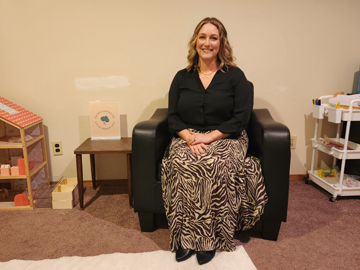
Freeman offers different types of therapies for all ages in the Jacksonville area
By Ben Cox
Photos/Ben Cox
Play is an essential part of people’s lives — both child and adult. Specifically with children, it helps with their social-emotional growth and expression.
Play therapy is an alternative proposal of intervention on important issues related to children, especially those who have trouble expressing their thoughts, feelings, desires and anxiety verbally.
Swiss psychologist Jean Piaget pioneered some of the initial thoughts on play therapy during the 1920s and 1930s. Piaget and his contemporary Melanie Klein began to use play as a means of analyzing children under the age of six.
Piaget’s ideas were then rediscovered and more studies were completed starting in the 1940s, namely with Anna Freud. Freud used play as a means to facilitate an attachment to the therapist and supposedly gain access to the child’s psyche. Freud’s father, Sigmund Freud, used it in a proto-therapeutic use at the turn of the 20th century to help aid a child suffering from a phobia of horses.
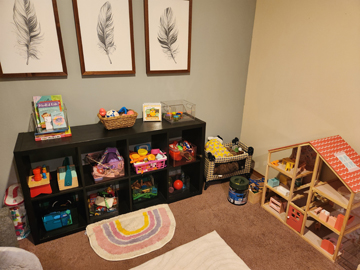
Today, play therapy has its own methodology and specialized training for clinicians. Play therapy comes in two forms: non-directed and directed. Jacksonville now has a specialized psychologist who provides both methods to help either as a primary intervention or as a supportive therapy for children, and to a lesser degree, some adults.
Sarah Freeman opened her office at 201 East Morgan St., inside of Dr. Edd Scott’s office last month. Freeman, a licensed play therapist, wanted to open her practice after living and training in the Kansas City area and needing to find work. After spending a year working in Springfield, Freeman says her dream of opening her own practice came true, “The fact that there’s no services in Jacksonville was an opportunity, an opportunity to help people and also to start something that would allow me to be closer to home and to just start something that bridges that gap. I know that there’s a few mental health services in the area, but it’s very limited and there’s really nothing for children, which is my specialty.” Freeman says she hopes to provide parents an option in town, instead of having to drive an hour or so in each direction for appointments each week.
Freeman says parents shouldn’t just view her office as a place where children get to come and play around with toys for an hour a week. She says the evidence-based therapy model goes much deeper than a child using their imagination with a set of toys.
“It’s a very child-led experience and I’m trained to observe and analyze the play that they’re engaging in and then join them in that play and use playful methods to help them through maybe stuck points or things that they’re needing to process,” Freeman explains, “Play therapy can be effective for skill building, cognitive-behavioral therapy, things like that. It also can be more of an implicit skill building. With non-directive play therapy, there’s so many areas of growth. They’re learning social skills, they’re problem solving, they’re growing in confidence and self-esteem, all sorts of areas of growth.” She says the non-directive play therapy is very beneficial for helping a child access parts of the brain and the thoughts they can’t yet verbalize to adults.
Freeman says she’s hoping to make connections with local schools, day cares and others who work with children to offer her services. She says that her work is not just limited to really young children either, “More directive play therapy is a better fit for the teenage years. They will come in and do art. I’ll have paint and bracelet making. I have my sand tray, which is a really expressive hands-on type of therapy. With the sand tray and art, I will sometimes use that with adults, too. There’s really no [age] limits on that.
“I’m trained in a few other models that I can use as well, but if it was something that I needed to refer [the client] out to someone, then we would talk about that and I would look for referrals elsewhere and try to do a warm handoff when possible.”
Freeman says her services also include individual therapy, family therapy and various consultation services. She works on a self-referral method, so anyone interested should come by her office, call 217-666-2683 or email sarah@freemancounseling.org. Freeman says she wants to help bridge the gap of mental health services in the community and surrounding areas by providing this specialized service.
